
The Stochastic Oscillator is a powerful technical indicator that helps traders assess where a security's price closes relative to its price range over a specific time frame.
This indicator is represented by two lines: the main line, known as %K, and a second line, called %D, which is essentially a Moving Average of %K. Typically, the %K line is shown as a solid line, while %D appears as a dotted line.
There are several ways to interpret the Stochastic Oscillator. Here are three popular strategies:
- Buy when the Oscillator (either %K or %D) dips below a certain level (like 20) and then crosses back above that level. Conversely, sell when the Oscillator climbs above a certain level (such as 80) and then drops below it;
- Buy when the %K line crosses above the %D line, and sell when the %K line dips below the %D line;
- Watch for divergences, such as when prices are hitting new highs while the Stochastic Oscillator fails to reach new highs.
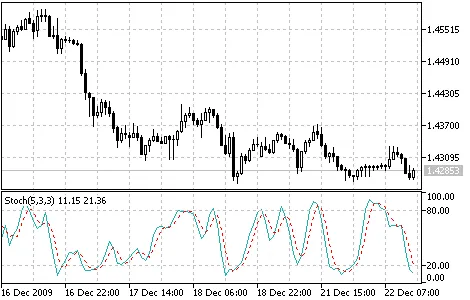
Stochastic Oscillator
Calculation:
To effectively use the Stochastic Oscillator, it’s important to understand its four key variables:
- %K period: This indicates the number of periods used in the stochastic calculation;
- %K Slowing Period: This value determines the internal smoothing of %K. A value of 1 is a fast stochastic, while 3 is considered slow;
- %D period: This is the number of periods used to calculate the moving average of %K;
- %D smoothing method: This refers to the method (e.g., Exponential, Simple, Smoothed, or Weighted) used for calculating %D.
The formula for %K is as follows:
%K = (CLOSE - LOW(%K)) / (HIGH(%K) - LOW(%K)) * 100
Where:
- CLOSE - represents today’s closing price;
- LOW(%K) - the lowest low over the %K periods;
- HIGH(%K) - the highest high over the %K periods.
The %D moving average is calculated using the formula:
%D = SMA(%K, N)
Where:
- N - is the smoothing period;
- SMA - stands for Simple Moving Average.




Comments 0