
Author: John Tirone
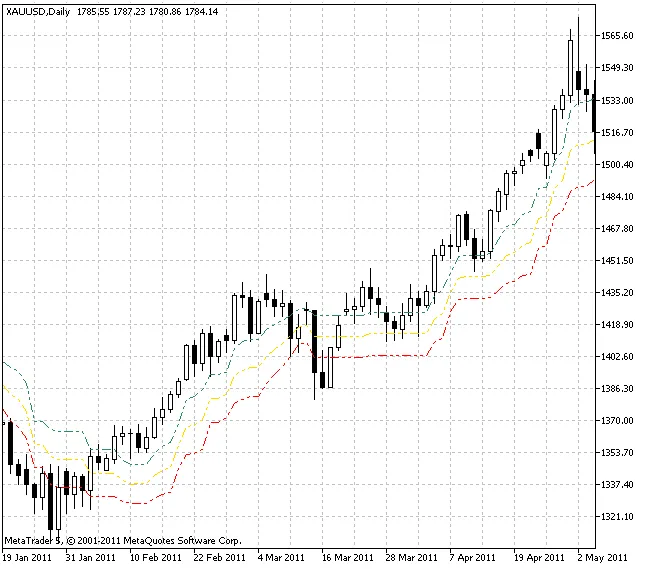
Tirone Levels are handy support and resistance markers that help traders gauge price movements based on a defined trading range over a specific timeframe.
These levels are primarily used to enhance our understanding of market price action. To calculate the three Tirone Levels, we employ the Midpoint method.
First, we need to determine the market's highest and lowest prices over a set period.
- To find the upper line, subtract the minimum price from the maximum price, divide that result by 3, and then subtract it from the maximum price.
- For the center line, subtract the minimum from the maximum, divide that result by 2, and add it to the minimum price.
- To calculate the lower line, once again subtract the minimum from the maximum, divide by 3, and add this result to the minimum price.
Here’s the formula breakdown:
Tirone Level 1 = High - (High - Low) / 3
Tirone Level 2 = Low + (High - Low) / 2
Tirone Level 3 = Low + (High - Low) / 3
Where:
- High (Highest High) - the peak price over your chosen period, say, 20 bars.
- Low (Lowest Low) - the lowest price for the same period.
Using Tirone Levels is quite similar to applying Fibonacci retracement levels. Essentially, you’ll want to buy when the price dips below the Tirone level and sell when it climbs above it.
Both methods utilize a percentage value to create these lines, with 50% often acting as a potential reversal point. You can also see some similarities with Quadrant Lines.
Like many other technical analysis tools, Tirone Levels have their advocates and are considered one of the more straightforward trading signal systems based on support and resistance. However, it's worth noting that traders who operate on shorter timeframes often find them less reliable compared to other techniques.




Comments 0