
Detección del Patrón de Spike Alcista
Patrón de 3 velas:
1ª vela: Verde con cuerpo grande (spike alcista).
2ª vela: Roja (retroceso).
3ª vela: Verde con cuerpo grande (spike alcista).
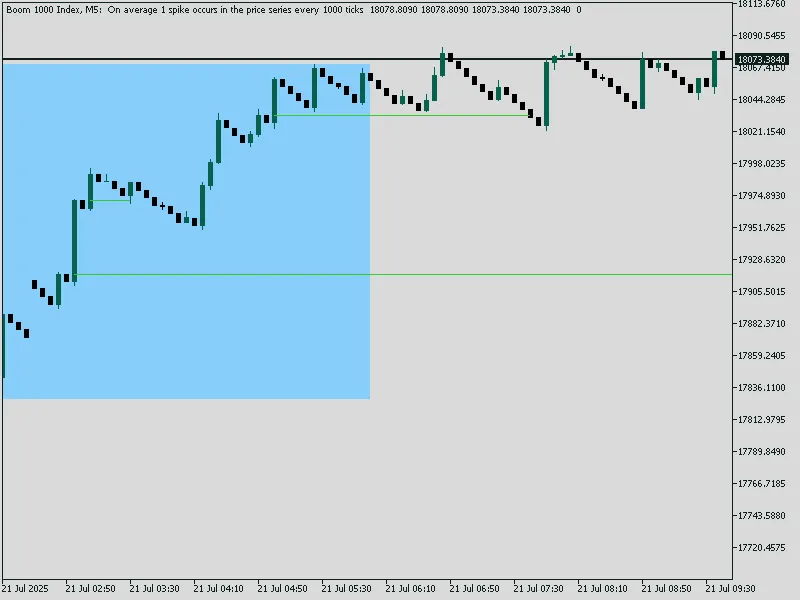
Cuando aparece este patrón, se crea una zona.
Creación de la Zona
Se dibuja un rectángulo azul desde el rango alto/bajo de las 3 velas.
Se dibuja una línea de entrada horizontal verde lima al precio de apertura de la vela del medio (2ª vela).
La línea se extiende hacia el futuro hasta que el precio regrese.
EXPLICACIÓN DE ENTRADAS
mq5
input color BoxColor = clrBlue; // Color del rectángulo del patrón de 3 velas
input color EntryLineColor = clrLime; // Color de la línea de entrada
input ENUM_LINE_STYLE EntryLineStyle = STYLE_SOLID; // Estilo de la línea de entrada
input int BoxWidth = 2; // Ancho del borde del rectángulo
input int EntryLineWidth = 2; // Ancho de la línea de entrada
input int EntryLineLength = 200; // Extensión de la línea de mitigación
IDEA PRINCIPAL
Buscamos un patrón alcista de 3 velas:
1. Primera vela – fuerte alcista (spike)
2. Segunda vela – retroceso bajista
3. Tercera vela – fuerte spike alcista nuevamente
Cuando esto aparece, dibujamos:
- Un rectángulo alrededor del patrón
- Una línea horizontal en la apertura de la 2ª vela (punto de entrada)
Una vez que el precio regresa a esa línea ("mitigación"), cortamos la línea y evitamos redibujarla.
ESTRUCTURAS DE DATOS
struct PatternInfo {
  datetime time; // Tiempo del patrón
  double entry; // Precio de entrada (apertura de la 2ª vela)
  double high; // Máximo de las 3 velas
  double low; // Mínimo de las 3 velas
  bool mitigated; // ¿El precio ha vuelto al nivel de entrada?
};

CArrayObj activePatterns;
Usamos una struct `PatternInfo` para rastrear cada patrón válido y almacenarlo en un array. Esto ayuda a evitar un procesamiento repetido.
FUNCIÓN DE INICIO
intOnInit() {
  IndicatorSetInteger(INDICATOR_DIGITS, _Digits);
  ArrayInitialize(activePatterns, 0);
  returnINIT_SUCCEEDED;
}
Establecemos la precisión del indicador y preparamos nuestro array.
DETECCIÓN DEL PATRÓN (EN CADA TICK)
```mq5
for (int i = limit - 3; i >= 0; i--) {
```
Recorremos las velas y buscamos 3 barras atrás.
```mq5
if (isBullish(i+2) && isBearish(i+1) && isBullish(i))
```
Verificamos si las últimas 3 velas encajan en el patrón de spike: Verde-Rojo-Verde.
```mq5
double high = MathMax(MathMax(High[i], High[i+1]), High[i+2]);
double low = MathMin(MathMin(Low[i], Low[i+1]), Low[i+2]);
double entry = Open[i+1];
```
Extraemos el alto/bajo para el rectángulo y el nivel de entrada de la 2ª (vela del medio).
```mq5
PatternInfo *pattern = new PatternInfo;
pattern.time = Time[i];
pattern.entry = entry;
pattern.high = high;
pattern.low = low;
pattern.mitigated = false;
```
Crearemos y añadiremos este patrón a nuestra lista.
```mq5
string boxName = "Box_" + IntegerToString(Time[i]);
ObjectCreate(0, boxName, OBJ_RECTANGLE, 0, Time[i+2], high, Time[i], low);
```
Dibujamos el rectángulo (caja) desde el patrón de 3 velas.
```mq5
string lineName = "EntryLine_" + IntegerToString(Time[i]);
ObjectCreate(0, lineName, OBJ_TREND, 0, Time[i], entry, Time[i] + PeriodSeconds() * EntryLineLength, entry);
```
Dibujamos la línea de entrada desde la apertura de la 2ª vela hacia adelante en el tiempo.
VERIFICACIÓN DE MITIGACIÓN (EN CADA TICK)
```mq5
// Recorremos todos los patrones:
for (int p = 0; p < activePatterns.Total(); p++) {
  PatternInfo *pt = (PatternInfo*)activePatterns.At(p);
```
Si no ha sido mitigado, verificamos:
```mq5
if (!pt.mitigated && Low[0] <= pt.entry)
```
Si el precio actual toca el nivel de entrada:
```mq5
pt.mitigated = true;
ObjectDelete("EntryLine_" + IntegerToString(pt.time));
```
Eliminamos la línea original.
```mq5
ObjectCreate(0, "MitigatedLine_" + IntegerToString(pt.time), OBJ_TREND, 0,
pt.time, pt.entry,
Time[0], pt.entry);
```
Crearemos una línea corta que muestra dónde ocurrió la mitigación.
FUNCIONES AUXILIARES### Verificar Alcista/Bajista:
```mq5
bool isBullish(int i) {
  return Close[i] > Open[i];
}

bool isBearish(int i) {
  return Close[i] < Open[i];
}
```
Este indicador es simple pero poderoso:
- Detecta el comportamiento real de spikes en Boom
- Visualiza las entradas inteligentes del dinero
- Detecta automáticamente la mitigación
Ahora puedes probarlo en vivo en Boom 500 o Boom 1000.




Comentarios 0