
If you're looking to enhance your trading strategy, the Daily Pivot Points indicator is a must-have for your MetaTrader 5 toolkit. Unlike some tools that lag behind the market, this indicator provides real-time insights into potential future movements.
So, what exactly are Daily Pivot Points? They’re calculated using the previous day's high, low, and close prices, giving you a solid framework for understanding minor trends throughout the current trading day. Essentially, the Pivot Point (PP) acts as a central point that the price tends to gravitate towards during market hours.
From that central point, we derive 13 levels for smaller timeframes: the equilibrium point, along with six resistance levels and six support levels. These levels, often referred to as 'check points,' are crucial for traders as they help in determining the overall trend direction.
The three most important values to keep an eye on are the equilibrium point, Resistance1 (RES1.0), and Support1 (SUP1.0). You’ll often notice that price movements pause or even reverse when it hits these levels, making them key areas for potential trade actions.
Here’s how the Daily Pivot Points can aid your trading:
- Forecast the expected price range for the day.
- Indicate potential price stops.
- Highlight possible reversal points in price movement.
If the market opens above the equilibrium point, it’s a signal to consider opening long positions. Conversely, if it opens below the equilibrium point, it might be a good day for short positions.
The check points come into play when monitoring for reversals or breaks at the resistance level RES1.0 or support level SUP1.0. Typically, as the price approaches RES2.0, RES3.0, or SUP2.0, SUP3.0, the market tends to become overbought or oversold, making these levels prime exit points for trades.
This indicator was originally implemented in MQL4 and has been a staple for traders since its publication on Code Base at mql4.com on December 23, 2005.
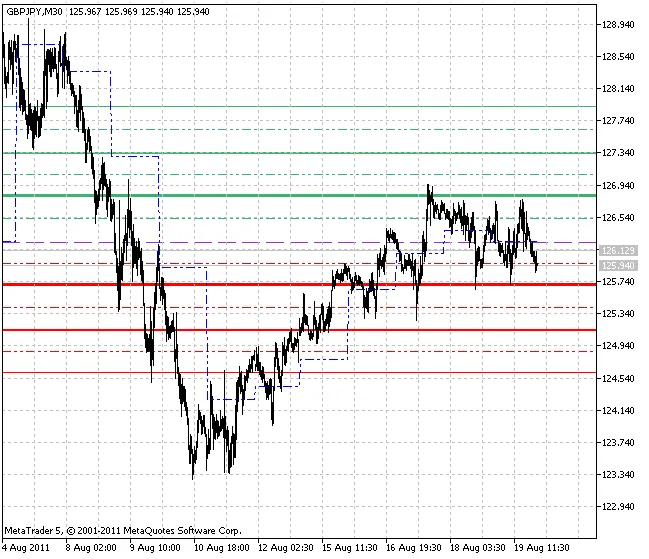
How are Pivot Points Calculated?
The calculation is based on the previous day’s HIGH, LOW, and CLOSE values, generating new values for Pivot Point (PP), Resistance (RES1.0, RES2.0, RES3.0), and Support (SUP1.0, SUP2.0, SUP3.0), as well as intermediate resistance and support levels.
PP = (HIGH + LOW + CLOSE) / 3
RES1.0 = 2*PP - LOW
RES2.0 = PP + (HIGH - LOW)
RES3.0 = 2*PP + (HIGH – 2*LOW)
SUP1.0 = 2*PP – HIGH
SUP2.0 = PP - (HIGH – LOW)
SUP3.0 = 2*PP - (2*HIGH – LOW)
RES0.5 = (PP + RES1.0) / 2
RES1.5 = (RES1.0 + RES2.0) / 2
RES2.5 = (RES2.0 + RES3.0) / 2
SUP0.5 = (PP + SUP1.0) / 2
SUP1.5 = (SUP1.0 + SUP2.0) / 2
SUP2.5 = (SUP2.0 + SUP3.0) / 2
Where:
- HIGH - the maximum price of the previous day;
- LOW - the minimum price of the previous day;
- CLOSE - the closing price of the previous day;
- PP - the equilibrium point (typical price of the previous day);
- RES0.5, RES1.0, RES1.5, RES2.0, RES2.5, RES3.0 - the resistance check points;
- SUP0.5, SUP1.0, SUP1.5, SUP2.0, SUP2.5, SUP3.0 - the support check points.




Comments 0