
The Standard Deviation Indicator (often referred to as StdDev) is a key tool for measuring market volatility. It essentially tells us how much the prices deviate from the moving average.
When the Standard Deviation is high, it indicates that the market is quite volatile, meaning prices are scattered significantly around the moving average. On the flip side, a low Standard Deviation suggests a stable market, where prices are closely clustered around the moving average. Remember, the market tends to fluctuate between these calm periods and active spikes.
So, how do we approach using this indicator? It’s pretty straightforward:
If the StdDev value is unusually low, signaling a calm market, it’s reasonable to anticipate an upcoming spike in activity.
Conversely, if the StdDev is extremely high, it often suggests that market activity is about to slow down.
How to Calculate Standard Deviation
StdDev (i) = SQRT (AMOUNT (j = i - N, i) / N)
AMOUNT (j = i - N, i) = SUM ((ApPRICE (j) - MA (ApPRICE (i), N, i)) ^ 2)
Where:
- StdDev (i) — Standard Deviation of the current bar;
- SQRT — square root;
- AMOUNT(j = i - N, i) — sum of squares from j = i - N to i;
- N — smoothing period;
- ApPRICE (j) — applied price of the j-th bar;
- MA (ApPRICE (i), N, i) — moving average of the current bar for N periods;
- ApPRICE (i) — applied price of the current bar.
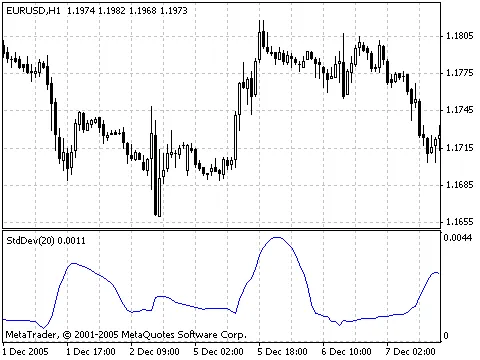
For a comprehensive look at the StdDev indicator, check out the Technical Analysis: Standard Deviation section.




Comments 0