
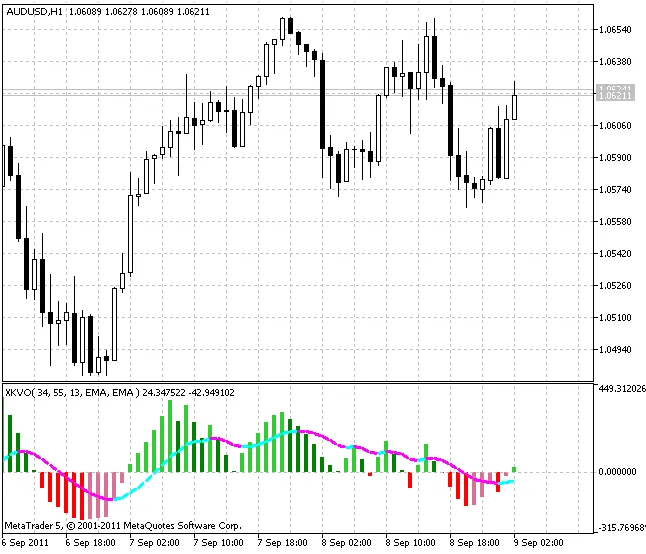
The Klinger Volume Oscillator (KVO) was created by Stephen Klinger and has become a staple for many traders. What makes the KVO unique is that it balances short-term signals of market tops and bottoms with a robust indication of long-term money flow. This dual functionality allows traders to gain insights into both immediate and sustained market trends.
Here’s how the KVO operates:
- Price range indicates movement while volume reflects the strength of that movement. By adding High, Low, and Close prices, you can identify a trend. If today's total exceeds yesterday's, it suggests accumulation; if it's less, there’s distribution. If the totals are equal, the current trend remains unchanged.
- Volume fluctuations impact intraday prices, showcasing buyer and seller strength. The KVO measures this strength by calculating the difference between accumulated and distributed shares daily. A high and rising volume indicates an impending bullish trend, while a gradual decline in volume often precedes the end of a bullish trend and the start of a bearish one. A resurgence in volume strength signals potential accumulation before a market bottom forms.
- Once the volume strength is transformed into an oscillator, representing the difference between the 34-day and 55-day exponential moving averages with a 13-day signal line, it becomes easier to track market entry and exit points. Comparing this volume strength with price movements can help you spot divergences between tops and bottoms.
Klinger emphasizes these key concepts when using the KVO:
- The most reliable signals align with the prevailing trend;
- The strongest signal is a divergence between new price highs/lows and the indicator, particularly in overbought/oversold zones;
- In a bullish trend, look to buy when the KVO drops to significantly low levels (below zero) and then turns upward, crossing its signal line. Conversely, during a bearish trend, consider selling when the KVO rises to high levels (above zero) and then turns down, crossing its signal line.
It’s essential to remember that the KVO performs best when trading in the direction of the trend. It tends to be less effective when going against it.
This indicator allows you to choose from ten distinct options for smoothing the histogram and the KVO signal line:
- SMA - Simple Moving Average;
- EMA - Exponential Moving Average;
- SMMA - Smoothed Moving Average;
- LWMA - Linear Weighted Moving Average;
- JJMA - JMA Adaptive Moving Average;
- JurX - Ultra Linear Smoothing;
- ParMA - Parabolic Smoothing;
- T3 - Tillson's Multiple Exponential Smoothing;
- VIDYA - Tushar Chande's Algorithm Smoothing;
- AMA - Perry Kaufman's Algorithm Smoothing.
It's important to note that the parameters Phase1 and Phase2 vary significantly across different smoothing algorithms. For JMA, Phase is an external variable ranging from -100 to +100. For T3, it’s a smoothing ratio multiplied by 100 for better visualization. For VIDYA, it represents the oscillator CMO period, while for AMA, it refers to the slow EMA period. These parameters don't influence smoothing calculations in other algorithms. In AMA, the fast EMA period defaults to a fixed value of 2, and the growth factor for AMA is also set to 2.
This indicator utilizes the SmoothAlgorithms.mqh class library (which should be copied to terminal_data_folder\MQL5\Include). More details on using this class are outlined in the article "Average Price Series for Intermediate Calculations without Extra Buffers".




Comments 0