
What is the Normalized MFI Indicator?
The Normalized Money Flow Index (MFI) is a handy tool for traders looking to gauge market momentum. Developed by John Bollinger, this indicator helps identify overbought and oversold conditions through the use of Bollinger Bands.
Key Parameters of the Normalized MFI
When using the Normalized MFI, you'll find four essential input parameters to consider:
- MFI Period: This is the timeframe over which the MFI is calculated.
- MFI Applied Volume: The volume you choose to use for the MFI calculation.
- BB Period: The period used for calculating Bollinger Bands.
- BB Deviation: This refers to the deviation used in the Bollinger Bands calculation.
How is the Normalized MFI Calculated?
The calculation for the Normalized MFI is straightforward:
NormMFI = (MFI - BL) / (TL - BL)
Where:
TL = BBands(MFI, BB period, BB deviation, UPPER_BAND)
BL = BBands(MFI, BB period, BB deviation, LOWER_BAND)
MFI - Money Flow Index (calculated using MFI period and MFI applied volume)
BBands - This refers to both UPPER_BAND and LOWER_BAND of the Bollinger Bands.
Visual Representation
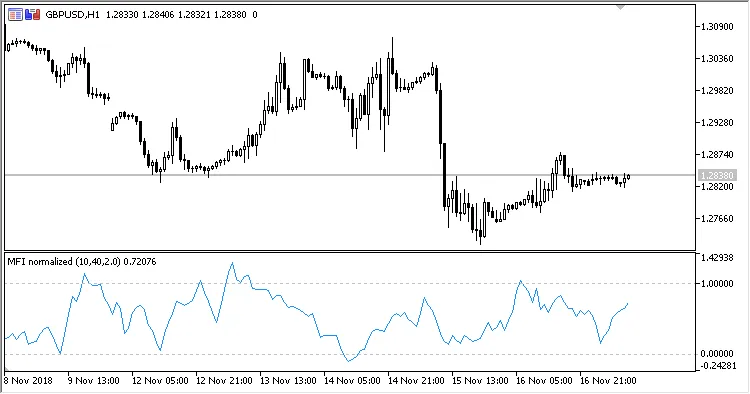
Fig.1. MFI Normalized
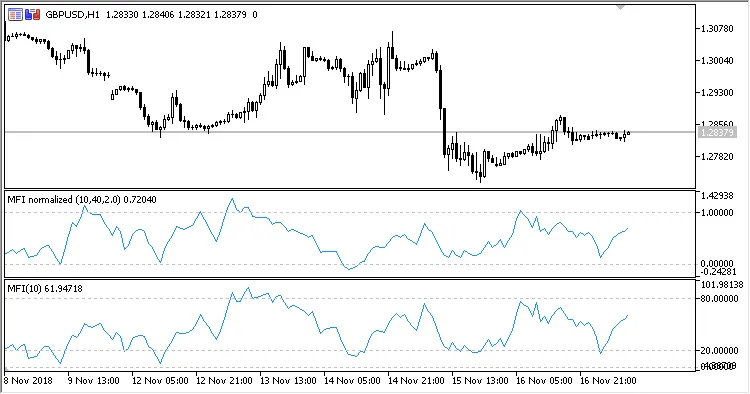
Fig.2. MFI Normalized + MFI




Comments 0