
Relative Strength Oscillator (RSO) is essentially an oscillator version of the well-known Relative Strength Index (RSI). The RSI has gained a solid reputation as a powerful and accurate trading indicator, varying between 0 and 100. Typically, traders look for readings in the 70s or 30s on the RSI to make their trading decisions. However, the RSO offers a more symmetrical and readable approach that’s particularly useful for comparison.
Unlike the RSI, which operates within a range of 0 to 100, the RSO oscillates around a center line of 0.0. It effectively shifts everything down by 50 points, placing overbought and oversold thresholds at 20 and -20, respectively.
I’ve added colored bars to enhance clarity. Green bars indicate an increase in the RSO, while red bars show a decrease. This visual representation allows traders to catch small fluctuations more easily than the curves of the RSO or RSI alone. For instance, when the RSO moves above 20, the first red bar signals a potential direction change, making it easier to interpret at a glance.
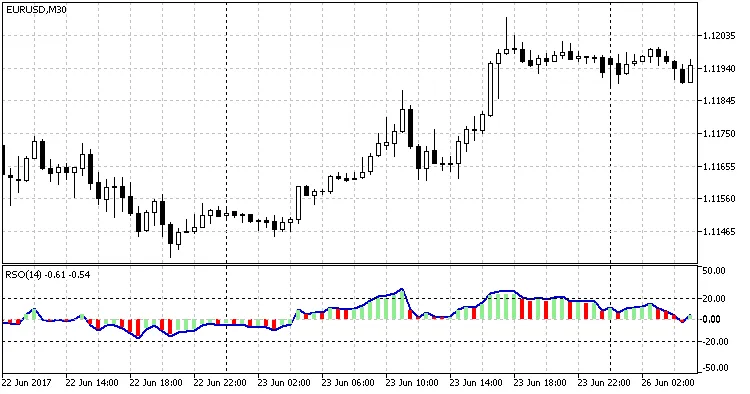
Fig 1. RSO indicator
The sequential green and red bars indicate that we might need to wait for a clearer direction change. As shown in the next image, when the RSO hovers around 20 and begins to decrease, we might be tempted to open a short position. However, the presence of sequentially opposite color bars serves as a valuable alert, reminding us to hold off on any trading action.
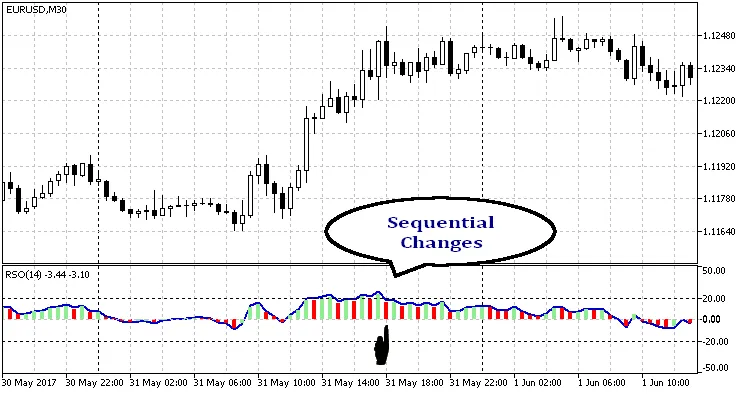
Fig 2. RSO sequential color change
For the development of the RSO, I utilized the original RSI source code from MetaQuotes as a foundation.




Comments 0