
Hey there, fellow traders! Today, we’re diving into the ins and outs of the Relative Vigor Index (RVI). This nifty indicator can really help you gauge the strength of market movements.
So, what’s the deal with the RVI? In a bull market, you’ll typically find that the closing price is higher than the opening price. Flip that around for a bear market, where the opposite tends to hold true. The RVI measures the "vigor" or energy behind price movements, based on where prices close at the end of the trading session. To make sense of the index relative to the daily trading range, we normalize it by dividing the price change by the maximum price range of the day.
For smoother calculations, we apply a symmetrically weighted moving average that takes into account the differences between closing and opening prices, as well as the maximum and minimum prices of each bar. Generally, a period of 10 is recommended for computing the indicator.
To clear up any confusion, it's a good practice to set up a signal line—a symmetrically weighted moving average of the RVI values. When these lines converge, it’s time to pay attention; it can signal a potential buy or sell opportunity.
How to Calculate the RVI
Here’s the formula breakdown:
VALUE1 = ((CLOSE - OPEN) + 2 * (CLOSE (1)) – OPEN (1)) + 2*(CLOSE (2) – OPEN (2)) + (CLOSE (3) – OPEN (3))) / 6
VALUE2 = ((HIGH - LOW) + 2 * (HIGH (1) – LOW (1)) + 2*(HIGH (2)- LOW (2)) + (HIGH (3) – LOW (3))) / 6
NUM = SUM (VALUE1, N)
DENUM = SUM (VALUE2, N)
RVI = NUM / DENUM
RVISig = (RVI + 2 * RVI (1) + 2 * RVI (2) + RVI (3)) / 6
Where:
- OPEN — the opening price;
- HIGH — the highest price;
- LOW — the lowest price;
- CLOSE — the closing price;
- VALUE1 — symmetrically weighted moving average of the differences between closing and opening prices;
- VALUE2 — symmetrically weighted moving average of the differences between the highest and lowest prices;
- NUM — total of N importances of VALUE1;
- DENUM — total of N importances of VALUE2;
- RVI — value of the Relative Vigor Index for the current bar;
- RVISig — value of the RVI signal line for the current bar;
- N — period of the smoothing.
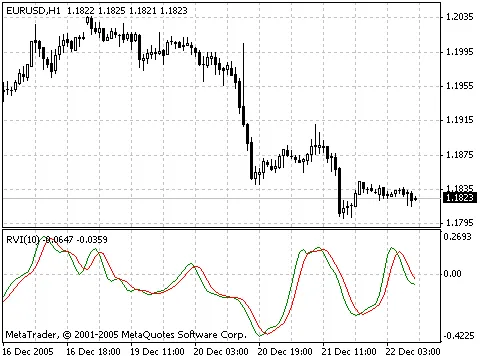
If you want to delve deeper, you can find a full description of the Relative Vigor Index over at MetaTrader 5's Technical Analysis on RVI. Happy trading!




Comments 0