
Hey there, fellow traders! Today, let’s dive into the BB XMACD, an innovative twist on the classic MACD (Moving Average Convergence/Divergence) indicator that can help pinpoint trend changes and measure trend strength effectively.
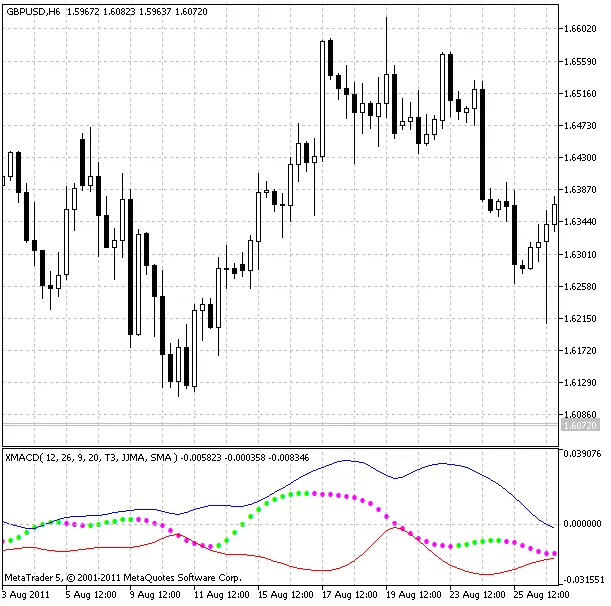
This indicator operates in a separate chart window and features two prominent lines (one blue and one red) along with dots that can appear in either green or magenta. Keep an eye on those dot colors—when they change, it’s often a strong signal! Plus, the distance between the two lines gives you a good indication of the current trend's strength.
For instance, take a look at the sample chart. When you notice magenta dots turning green, it's a signal to buy. Conversely, if the dots flip back to magenta, it’s time to consider selling. Ideally, you want to make trades when there’s a significant gap between the blue and red lines, as this often indicates a stronger trend.
One of the cool features of the BB XMACD is that it allows you to customize the smoothing type for the MACD histogram, signal line, and bands. You’ve got ten different options to choose from:
- SMA - Simple Moving Average;
- EMA - Exponential Moving Average;
- SMMA - Smoothed Moving Average;
- LWMA - Linear Weighted Moving Average;
- JJMA - JMA Adaptive Average;
- JurX - Ultralinear Smoothing;
- ParMA - Parabolic Smoothing;
- T3 - Tillson's Multiple Exponential Smoothing;
- VIDYA - Smoothing using Tushar Chande's Algorithm;
- AMA - Smoothing using Perry Kaufman's Algorithm.
It's worth mentioning that the Phase type parameters for different smoothing algorithms can vary significantly. For example, with JMA, the Phase variable ranges from -100 to +100. For T3, it represents a smoothing ratio multiplied by 100 for better clarity. Meanwhile, VIDYA uses a CMO oscillator period and AMA is based on a slow EMA period. Keep in mind that in some algorithms, these parameters don’t influence the smoothing process. For AMA, the fast EMA period defaults to a fixed value of 2, as does the power ratio.
To get the most out of this indicator, ensure you have the SmoothAlgorithms.mqh library classes copied to your terminal_data_folder/MQL5/Include. You can find more details about how to use these classes in the article "Averaging Price Series for Intermediate Calculations Without Using Additional Buffers".




Comments 0