
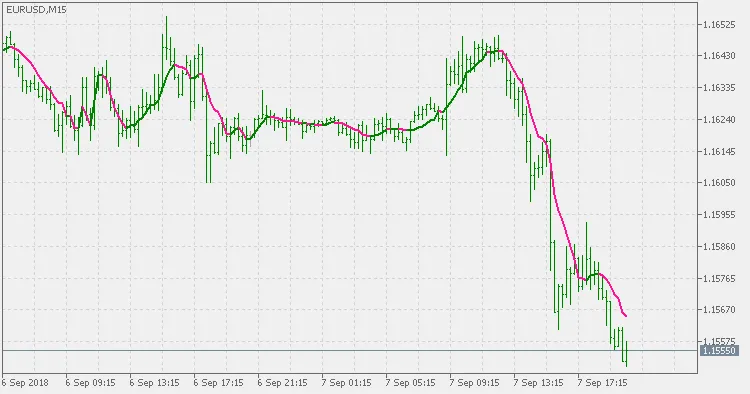
If you're looking for a fresh take on averages in your trading strategy, you've come to the right place! Today, we’re diving into the Adaptive Lookback Average, a game-changer for traders using MetaTrader 5. Unlike traditional averages that stick to a fixed period, this indicator adapts its calculation based on market movements, making it a flexible tool in your trading toolkit.
What is Adaptive Lookback?
The Adaptive Lookback is a market-driven indicator designed to determine variable lookback periods for various indicators, rather than relying on a static number. It’s a clever way of adapting to the market’s rhythm.
Here’s the scoop: the Adaptive Lookback method is based on the frequency of market swings. To put it simply, a swing high occurs when you see two consecutive higher highs followed by two lower highs, while a swing low is identified by two consecutive lower lows followed by two higher lows. Since these swing points often signal reversals, they’re more frequent in volatile markets compared to trending ones.
How to Determine the Adaptive Lookback Period
The adaptive lookback period is calculated through the following steps:
- Identify the initial number of swing points you want to use (this is your swing count parameter).
- Count how many price bars it takes for those n swing points to form.
- Divide the number of price bars from step 2 by the swing count from step 1, then round the result.
- As an extra tweak, adjust the “speed” of the adaptive period using the speed parameter: a smaller speed makes the average slower, while a larger speed increases its responsiveness.
Just a heads up: the speed parameter is a unique addition to the original adaptive lookback concept, giving you better control over the indicator's responsiveness.
Interpreting the Adaptive Lookback Average
What does this mean for your trading? In calm or trending markets, the variable lookback period will elongate, while in choppy and volatile markets, it will shorten. If you’re a trend-following trader, you may want the opposite to avoid being whipsawed by false signals. Thus, this indicator shines for short-term traders and counter-trend systems, where quick reactions and precise signaling are essential.
Averages You Can Calculate
The Adaptive Lookback Average can be applied to several types of averages, including:
- Simple Moving Average
- Exponential Moving Average
- Smoothed Moving Average
- Linear Weighted Moving Average
Related Posts
- Unlocking the Power of Master Tools for MetaTrader 4
- Mastering the MACD Candle Indicator for MetaTrader 4
- Unlocking MetaCOT 2: Your Ultimate CFTC Indicator Toolkit for MT4
- Unlock Trading Insights with Volume Profile + Range v6.0 for MetaTrader 5
- Mastering the FE Fibonacci Expansion Indicator for MetaTrader 4