
The Hikkake Pattern, often referred to as the Inside Day False Breakout, is a clever trading strategy that revolves around false breakouts. Originally inspired by Dan Chesler’s insightful article in April 2004 for Active Trader Magazine titled "Trading False Moves with the Hikkake Pattern," this indicator has been adapted into MQL5 code.
The Hikkake pattern is made up of two price bars—these could be hourly, daily, or even weekly bars. The first bar is known as the inside bar, which is characterized by having a lower high and a higher low than the preceding bar. For a bearish Hikkake setup, the second bar must have both a higher high and a higher low compared to the inside bar, whereas for a bullish setup, it needs to show a lower low and a lower high.
This two-bar structure encapsulates the essence of the pattern. It signals that the market has just broken out from an inside bar, enticing traders to jump on the breakout bandwagon.
However, just like a skilled athlete might feint to throw off their opponent, the market can do the same. The real intentions of the market only become apparent when it starts moving in the opposite direction of the initial breakout. As with any trading pattern, it’s crucial to wait for verification signs before making a move.
When it comes to the Hikkake pattern, a false move isn’t expected unless the price crosses above the high of the inside bar for a bullish setup, or below the low of the inside bar for a bearish setup. Also, this verification needs to happen within three bars of the Hikkake pattern—if it doesn’t, the pattern should be disregarded.
— Dan Chesler
For those interested, you can read the complete article by Dan Chesler here.
We've developed this indicator from the ground up, following Dan's theory closely.
- The indicator highlights the identified pattern with three large dots.
- Subsequently, three small dots appear on the next three candles, pointing to the theoretical entry points for trades.
- Once the price hits these theoretical entry points, a Buy or Sell arrow will pop up.
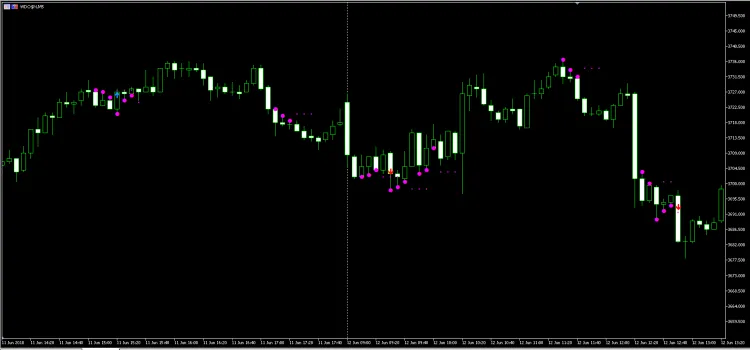
We truly hope this indicator proves beneficial to our trading community!
We’d love to hear your thoughts! Feel free to share any bugs, tips, or insights on which markets, stocks, and timeframes this indicator shines the most.




Comments 0