
The Average Daily Range (ADR) is a valuable indicator that helps traders gauge the volatility of an asset. It highlights the average price movement between the highest and lowest points over a specified number of days.
To compute the ADR, the indicator calculates the difference between the maximum and minimum prices for a set period, like 14 days, and then finds the average of these movements:
Average Day Range = SMA(High - Low, Length)
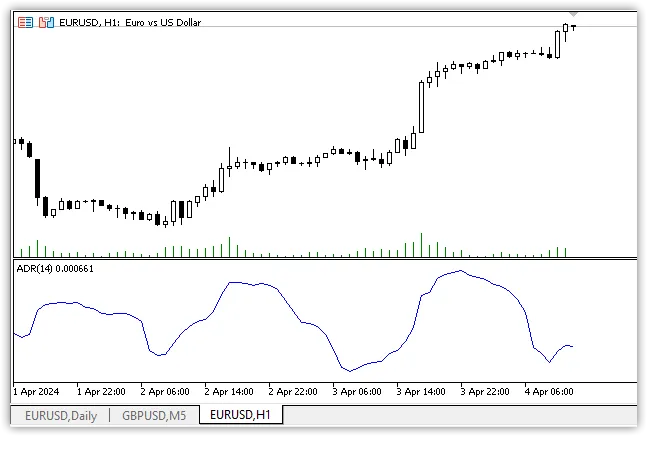
Both the Average Daily Range (ADR) and the Average True Range (ATR) are essential tools for analyzing market volatility, yet they are calculated and interpreted differently.
What is Average Daily Range (ADR)?
The Average Daily Range (ADR) measures the typical range of price fluctuations over a determined time frame. To determine the ADR, you would take the difference between the day’s high and low prices over a chosen period (commonly 14 days) and calculate the average of these differences. This provides traders with insights into the expected volatility of an asset during a trading day, helping them to craft their trading strategies accordingly.
Understanding Average True Range (ATR)
The Average True Range (ATR) also measures volatility, but it employs a slightly different calculation method, making it a more versatile and precise indicator. To calculate the ATR, you first find the true range for each day, which is the highest value among the following three:
- The difference between the current day’s high and low prices.
- The difference between the current day’s high price and the previous day’s close.
- The difference between the current day’s low price and the previous day’s close.
Next, you average these true range values over a specific period, often 14 days. The ATR takes into account price gaps between trading days, providing a more accurate picture of volatility, especially in markets where large price swings occur between sessions.
Key Differences Between ADR and ATR
- Calculation Methodology: ADR focuses solely on the average range between the day’s high and low prices, while ATR incorporates the gaps between closing and opening prices of consecutive trading days.
- Usage: ADR is primarily utilized for estimating daily volatility, whereas ATR serves as a broader measure of volatility that can be applied across various trading strategies, including risk management and setting stop-loss orders.
- Flexibility: ATR is often regarded as a more adaptable tool due to its ability to respond to changing market conditions and account for price gaps.




Comments 0