
Hey there, fellow traders! Today, let’s dive into the On Balance Volume (OBV) indicator, a handy tool that helps us gauge market momentum by relating volume to price changes. Developed by Joseph Granville, the OBV is pretty straightforward.
Here’s the deal: when a security closes higher than its previous close, all of that day’s volume is counted as up-volume. Conversely, if it closes lower, the entire volume is considered down-volume. It’s a simple, yet powerful way to assess market strength.
The core idea behind OBV analysis is that changes in OBV often come before price changes. Essentially, when smart money starts flowing into a security, you’ll usually see a rising OBV. Then, when retail traders jump in, both the price and the OBV tend to surge together.
But what happens when the price moves without a corresponding OBV change? That’s what we call a “non-confirmation.” You’ll often see these at market tops during bullish trends (when prices rise before the OBV does) or at market bottoms in bearish trends (when prices drop without the OBV confirming the move).
When the OBV is on the rise, you’ll notice each new peak is higher than the last, and each trough is also climbing. In contrast, the OBV is in a downward trend if each peak and trough is lower than the previous ones. If the OBV is moving sideways without making new highs or lows, it’s a sign of uncertainty.
Once a trend is established, it usually sticks around until it gets broken. There are two main ways for the OBV trend to change. The first is a shift from rising to falling, or vice versa. The second is when it transitions into a doubtful trend—and if that doubt sticks around for more than three days, that’s a signal to pay attention.
So, if you see the OBV shift to a rising or falling trend, that’s your breakout moment. Typically, OBV breakouts happen before price breakouts, so when you spot an upward breakout, consider taking a long position. On the flip side, if you see a downward breakout, it might be time to short. Just keep your positions open until the trend shifts again.
How to Calculate OBV
Calculating the OBV is pretty straightforward:
If today’s close is greater than yesterday’s close, then:
OBV(i) = OBV(i-1) + VOLUME(i)
If today’s close is less than yesterday’s close, then:
OBV(i) = OBV(i-1) - VOLUME(i)
If today’s close is equal to yesterday’s close, then:
OBV(i) = OBV(i-1)
Where:
- OBV(i) — is the current period's indicator value;
- OBV(i-1) — is the indicator value from the previous period;
- VOLUME(i) — is the volume for the current bar.
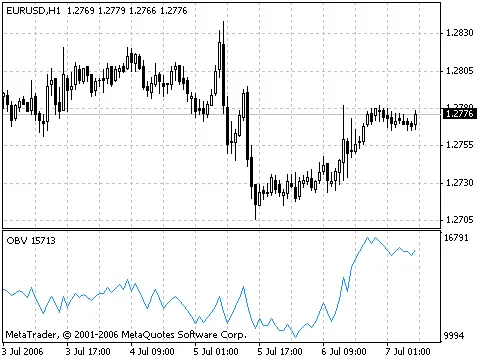
If you want to dive deeper into OBV, check out the full description in the Technical analysis: On Balance Volume.




Comments 0