
In the day-to-day trading arena, it's a constant tug-of-war between buyers, known as "Bulls," driving prices up, and sellers, or "Bears," pushing them down. The closing price of any given day will show whether the Bulls or Bears came out on top. By looking at intermediate results, particularly the day’s highest and lowest prices, we can gauge how the battle played out.
Being able to assess the balance of Bulls Power is crucial, as shifts in this balance can signal potential trend reversals. This is where the Bulls Power oscillator comes into play, a tool developed by Alexander Elder and detailed in his book "Trading for a Living: Psychology, Trading Tactics, Money Management". Elder's oscillator is grounded in a couple of key concepts:
- The moving average represents a price consensus between buyers and sellers over a set period.
- The highest price of the day reflects the peak strength of the buyers.
With these ideas in mind, Elder formulated Bulls Power as the difference between the highest price of the day and the 13-period exponential moving average (HIGH - EMA).
How to Use Bulls Power
This indicator works best in tandem with a trend indicator, like a Moving Average. Here’s how to interpret it:
- If the trend indicator points downward and the Bulls Power index is above zero but declining, consider this a sell signal.
- It’s also ideal to look for peak divergences forming on the indicator chart in this scenario.
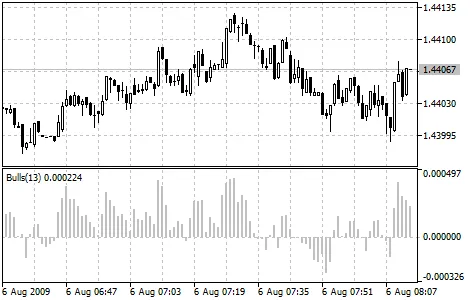
Calculation of Bulls Power
To calculate this indicator, you start with the exponential moving average, typically the 13-period EMA.
Where:
- BULLS - Represents the Bulls' Power;
- HIGH - The highest price of the current bar;
- EMA - The Exponential Moving Average.
In an uptrend, when HIGH exceeds EMA, Bulls Power is above zero, and the histogram will sit above the zero line. Conversely, if HIGH dips below EMA as prices fall, Bulls Power will drop below zero, and its histogram will fall under the zero line.




Comments 0