
Author: Raff
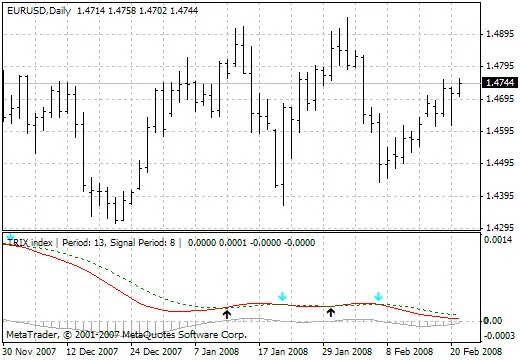
The Trix indicator is a powerful tool for traders looking to gauge overbought and oversold market conditions. It can also serve as an impulse indicator, helping you make more informed trading decisions. Like many oscillators, Trix values hover around zero. When you're using Trix as an oscillator, a positive value indicates an overbought market, while a negative value signals an oversold market.
When utilized as an impulse indicator, a positive Trix value suggests that market momentum is increasing, whereas a negative value indicates a declining impulse. This can be crucial for timing your trades effectively.
Many traders consider a signal to buy when Trix crosses below zero, while a move from below to above zero is typically seen as a sell signal. Divergence between the price and the Trix line can also signal potential turning points in market trends, making it a valuable indicator in your trading toolbox.
| Input | Type | Default Value | Description |
|---|---|---|---|
| Price | Number | Close | Price type for calculations |
| Length | Number | 18 | Amount of bars for calculations |
Trix calculates the triple exponential moving average based on the logarithmic price defined by the Price parameter for the duration specified by the Length parameter. In this calculation, the value of the current bar is subtracted from the previous bar's value, effectively filtering out cycles shorter than the Length parameter.
One of Trix's standout features compared to other trend-following indicators is its ability to filter out market noise and respond more quickly to changing market conditions. By leveraging the triple exponential moving average, Trix effectively ignores short-term cycles that could mislead traders. However, for best results, consider using Trix in conjunction with other indicators to minimize the risk of false signals.
Example: To assign the value of the Trix indicator for the High price over 14 bars, use the following code: Var1 = TRIX(High,14);




Comments 0