
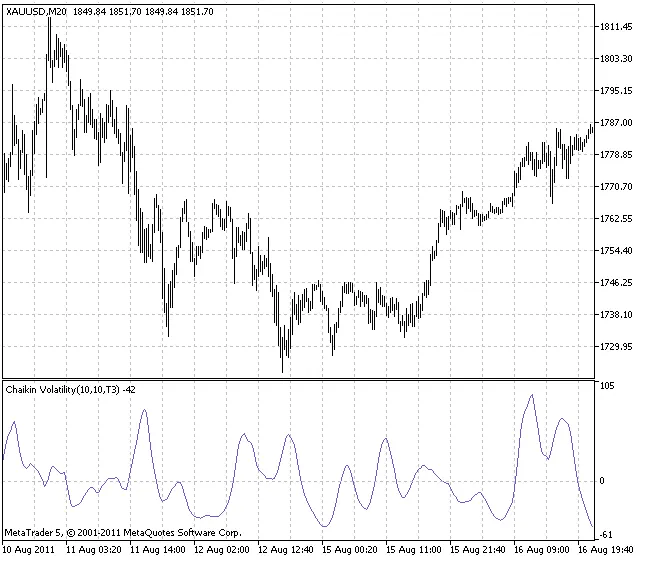
Hey fellow traders! Today, we're diving into the Chaikin Volatility Index and how you can take it to the next level by selecting the right smoothing algorithm. Unlike the standard version, this indicator allows you to pick from ten different smoothing methods to suit your trading style.
Options for Smoothing Algorithms
Here’s a quick rundown of the available algorithms:
- SMA - Simple Moving Average;
- EMA - Exponential Moving Average;
- SMMA - Smoothed Moving Average;
- LWMA - Linear Weighted Moving Average;
- JJMA - JMA Adaptive Average;
- JurX - Ultralinear Smoothing;
- ParMA - Parabolic Smoothing;
- T3 - Tillson's Multiple Exponential Smoothing;
- VIDYA - Smoothing using Tushar Chande's algorithm;
- AMA - Smoothing using Perry Kaufman's algorithm.
Understanding the Phase Parameter
It's important to note that the Phase parameter varies significantly among these algorithms:
- For JMA, it’s an external Phase variable that ranges from -100 to +100.
- For T3, it’s a smoothing ratio multiplied by 100 for better visualization.
- For VIDYA, it’s the CMO period; for AMA, it’s the slow EMA period.
- In the case of AMA, the fast EMA period is fixed at a default of 2, and the raising power ratio is also set to 2.
This indicator leverages the SmoothAlgorithms.mqh library classes, which you’ll need to copy into your terminal_data_folder\MQL5\Include. For a deeper dive into using these classes, check out the article titled "Averaging Price Series for Intermediate Calculations Without Using Additional Buffers".




Comments 0