
Force Index is a powerful technical indicator created by Alexander Elder that every trader should consider adding to their toolkit.
This index measures the strength of the market by evaluating the Bulls Power during price increases and the Bears Power during price declines. By linking price trends, drops, and trading volumes, the Force Index provides insights that can help you make informed trading decisions. While you can use the Force Index on its own, combining it with a Moving Average can enhance its effectiveness. For optimal results, apply a short moving average (the recommendation is to use 2 periods), which helps pinpoint the best moments to open and close trades. If you're using a longer moving average (like a 13-period), it can help identify overall trends and their shifts.
- Buy signals typically arise when the Force Index dips below zero during an upward trend.
- The index indicates a continuation of the bullish trend when it reaches a new peak.
- Look for sell signals when the index turns positive in a downward trend.
- When the index drops to a new low, it signals the Bears' Power and the ongoing bearish trend.
- If you see price changes that don’t match up with volume changes, the Force Index will stabilize, suggesting that a trend reversal could be on the horizon.
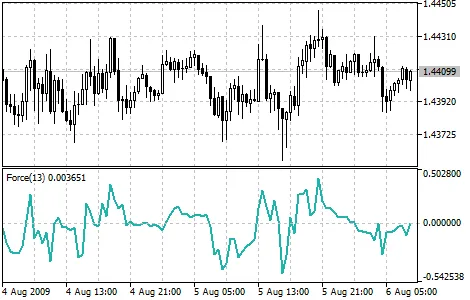
Force Index Indicator
How to Calculate the Force Index:
The Force Index measures market movements based on direction, magnitude, and volume. If the closing price of the current bar exceeds that of the previous bar, the force is positive. Conversely, if it’s lower, the force is negative. The greater the price difference, the stronger the force. Similarly, higher trading volumes amplify the force.
FORCE INDEX (i) = VOLUME (i) * ((MA (ApPRICE, N, i) - MA (ApPRICE, N, i-1))
Where:
- FORCE INDEX (i) - The Force Index of the current bar;
- VOLUME (i) - The volume of the current bar;
- MA (ApPRICE, N, i) - Any Moving Average of the current bar for N periods: Simple, Exponential, Weighted, or Smoothed;
- ApPRICE - Applied price;
- N - Averaging period;
- MA (ApPRICE, N, i-1) - Any Moving Average of the previous bar.




Comments 0