
If you're looking to elevate your trading game, the GMMA (Guppy Multiple Moving Average) is an indicator you definitely want to have in your toolkit. Developed by renowned trader Daryl Guppy, who has penned books like "Trend Trading", "Trading Tactics", and "Better Stock Trading: Money and Risk Management", this indicator offers valuable insights into market dynamics.
The GMMA indicator is built around the interaction of two groups of moving averages, helping you understand the behavior of two key market players: traders and investors. By utilizing this indicator, you can gain clarity on market relationships displayed on your charts, allowing you to select the most suitable trading strategies and tools.
The activity of traders is tracked through a set of short-term moving averages, typically set at periods of 3, 5, 8, 10, 12, and 15. These averages provide insight into when traders are starting new trends, often pushing prices upward as they anticipate a shift from a downtrend to an uptrend.
On the flip side, long-term investors tend to take a bit more time to recognize trend changes. Their presence is monitored through a set of long-term moving averages, which include periods of 30, 35, 40, 45, 50, and 60. A strong trend is usually supported by these investors entering the market.
The GMMA indicator shines in six key trading scenarios:
- Standard trend breakouts
- Joining the trend
- Exploiting price weaknesses
- Rallies and trend breakouts
- Selecting optimal exit points
- Trading bubbles
When it comes to smoothing algorithms, you have ten options to choose from:
- SMA - Simple Moving Average
- EMA - Exponential Moving Average
- SMMA - Smoothed Moving Average
- LWMA - Linear Weighted Moving Average
- JJMA - JMA Adaptive Average
- JurX - Ultralinear Smoothing
- ParMA - Parabolic Smoothing
- T3 - Tillson's Multiple Exponential Smoothing
- VIDYA - Smoothing using Tushar Chande's algorithm
- AMA - Smoothing using Perry Kaufman's algorithm
It's important to understand that the Phase1 and Phase2 parameters vary significantly across different smoothing algorithms. For instance, in JMA, the Phase variable ranges from -100 to +100, while in T3, it's a smoothing ratio multiplied by 100 for better visualization. For VIDYA, it's based on a CMO oscillator period, and for AMA, it's a slow EMA period. In other algorithms, these parameters generally don't affect smoothing, with a fixed fast EMA period for AMA set to 2 by default.
The GMMA indicator makes use of the SmoothAlgorithms.mqh library classes, which need to be copied to the terminal_data_folder\MQL5\Include. You can find detailed instructions on how to use these classes in the article "Averaging Price Series for Intermediate Calculations Without Using Additional Buffers".
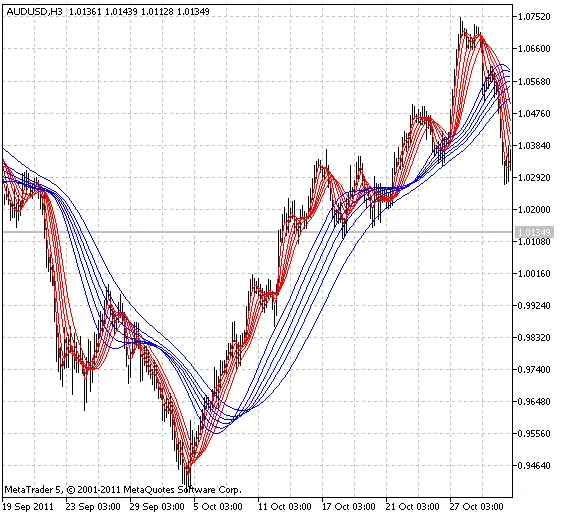
Here are the input parameters for the GMMA indicator:
//+-----------------------------------+//|  Indicator input parameters       |//+-----------------------------------+input Smooth_Method xMA_Method=MODE_EMA; // Averaging methodinputint TrLength1=3;   // 1 trader averaging period inputint TrLength2=5;   // 2 trader averaging period inputint TrLength3=8;   // 3 trader averaging period inputint TrLength4=10;  // 4 trader averaging period inputint TrLength5=12;  // 5 trader averaging periodinputint TrLength6=15;  // 6 trader averaging period inputint InvLength1=30; // 1 investor averaging periodinputint InvLength2=35; // 2 investor averaging periodinputint InvLength3=40; // 3 investor averaging periodinputint InvLength4=45; // 4 investor averaging periodinputint InvLength5=50; // 5 investor averaging periodinputint InvLength6=60; // 6 investor averaging period

inputint xPhase=100;                 // Smoothing parameterinput Applied_price_ IPC=PRICE_CLOSE; // Price constantinputint Shift=0;                    // Horizontal shift of the indicator in bars




Comments 0