
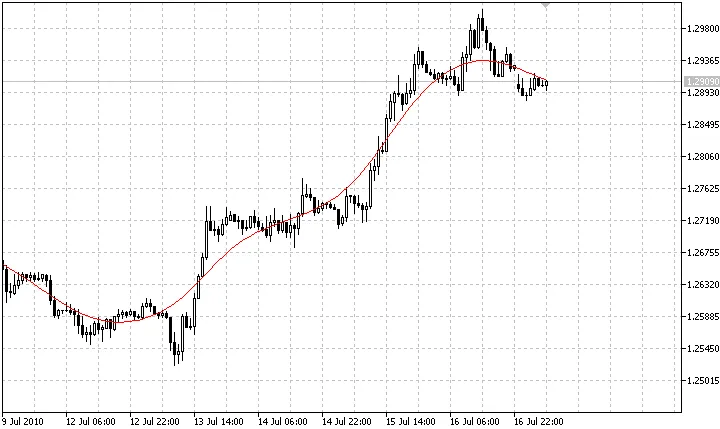
The Hodrick-Prescott filter is a tool that’s often discussed in macroeconomics, especially when it comes to analyzing real business cycles. Its main function is to help traders separate the cyclical components from the raw data in a time series. One notable feature is that it operates with zero lag, which sounds great but comes with its own set of challenges.
A common drawback of zero lag filters like this one is that recent values are recalculated, which can throw off your real-time analysis. I’ve experimented with the Hodrick-Prescott filter for various purposes—like identifying price channels and spotting trend changes. However, in my experience, it hasn’t proven to have significant advantages over other indicators like the EMA, LWMA, or AMA.
Interestingly, I’ve noticed that the prices smoothed by this filter seem to align closely with the principal component derived from Principal Component Analysis (PCA). This suggests there could be a mathematical relationship between the Hodrick-Prescott filter and PCA, which might open up new possibilities for its use. While I don’t personally use it, I’d love to hear your thoughts on how you think it could be applied in trading strategies.




Comments 0