
Hey there, fellow traders! Today, we’re diving into the latest and greatest—the Bounce Strength Indicator (BSI) 2.0. This nifty tool not only measures the strength of bounces but also integrates Tango Line calculations to give you an edge in your trading.
While the core concept remains the same, I’ve given it a fresh twist. Instead of relying on the width of the range like a traditional oscillator, this version opts for the deviation from the center line. And guess what? That center line is based on the moving average of the Tango Line.
double ratio=0;
 //--- Bar Spreaddouble sp=(high[k]-low[k]);
 //--- Not DownBarif(!(close[k-1]-sp*0.2>close[k]))
   {
    ratio=-1*(low[k]/TangoMaBuffer[k])+2;
    sumpos+=(close[k]-low[k])*ratio;
   }
 //--- Not UpBarif(!(close[k-1]+sp*0.2<close[k]))
   {
    ratio=-1*(high[k]/TangoMaBuffer[k])+2;
    sumneg+=(high[k]-close[k])*ratio;
   }
What’s on Display:
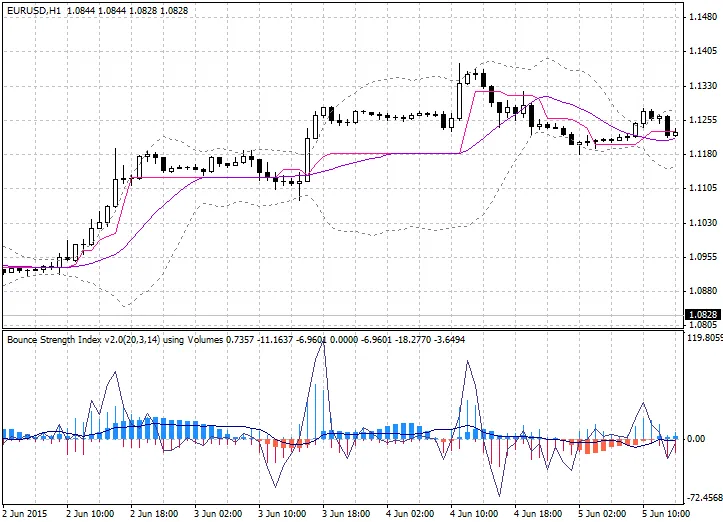
- Plus Histogram: Shows the bounce strength rising from the lows.
- Minus Histogram: Displays the bounce strength dropping from the highs.
- Signal Line: Represents the difference between plus and minus values calculated as [(plus - minus) * abs((plus-minus) / (plus+minus))].
- Blue Box: Indicates uptrend strength (average of Signal line).
- Red Box: Marks downtrend strength (average of Signal line).
- Slow Line: An average of the Signal line over a long span.
Check out the Tango Line chart window (version 1.1) for a visual aid!
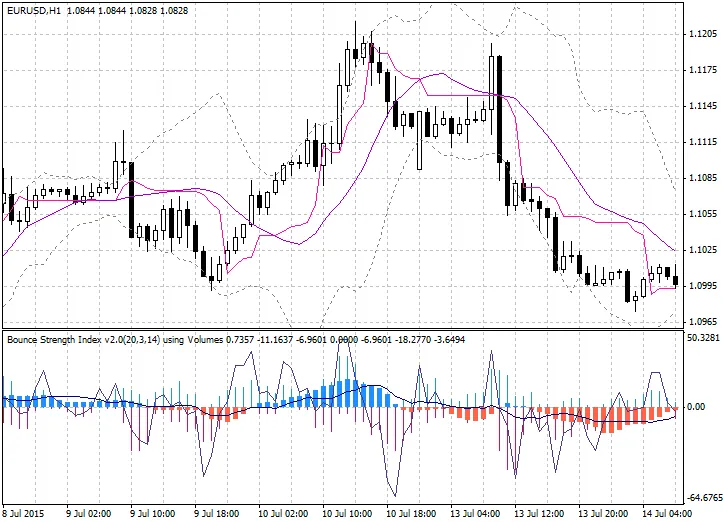
Trending charts can be a game-changer:
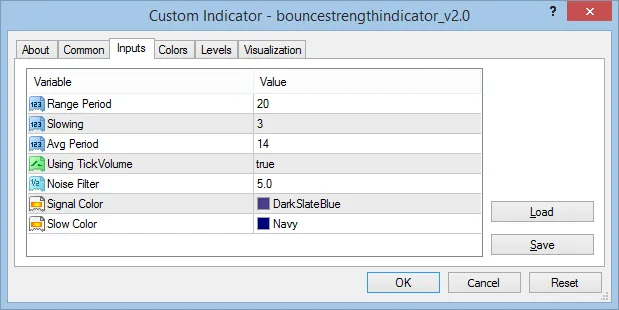
Settings to Tweak:
//--- input parametersinputint InpRangePeriod=20; // Range Periodinputint InpSlowing=3; // Slowinginputint InpAvgPeriod=14; // Avg Periodinputbool InpUsingVolumeWeight=true; // Using TickVolumeinputdouble InpReversalNoiseFilter=5; // Noise Filterinput color InpSigColor=DarkSlateBlue; // Signal Colorinput color InpSlowColor=Navy; // Slow Color




Comments 0