
If you're looking to sharpen your trading strategy, the CDRVolatility indicator is a fantastic tool to have in your arsenal. It helps you set your Stop Loss (S/L), Take Profit (T/P), and Trailing Stop (T/S) with greater precision.
The beauty of the CDRVolatility lies in its ability to show the largest upswing, known as the convergent signal, and the largest downswing, or the divergent signal, within your chosen time window. If the price is on the rise, you'll see those convergent signals shining through. Conversely, when the market dips, the largest downswing takes center stage as the convergent signal.
As these convergent and divergent curves move apart, your trading performance can see a noticeable boost. The divergent signal acts as a safety net for your Stop Loss (in pips), while the convergent signal guides you toward your Take Profit level and offers insight into overall range volatility.
One of the best parts? You have the flexibility to customize this indicator. You can adjust the window size, set your price movement threshold (in pips) for the open-to-close range, and determine the period for averaging the indicator.
Input Parameters:
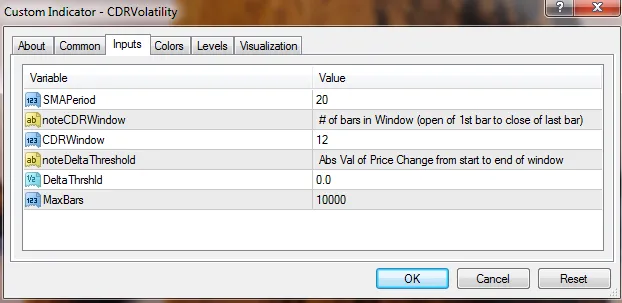
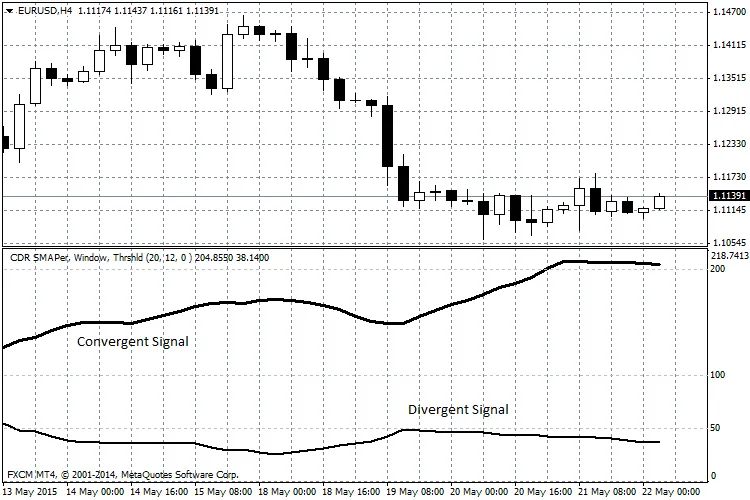
Fig.1. Convergent (Thick Line) and Divergent (Thin Line) Signals
Recommendations:
To make the most of the CDRVolatility indicator, set your price threshold so that it’s typically met within your selected window size for the chosen timeframe. The H1, H4, and D1 timeframes are ideal for this tool. For H4, a window size of 12 bars, a Simple Moving Average (SMA) period of 20, and a Delta Threshold of 20 or less work wonders.




Comments 0