
The Commodity Channel Index (CCI) is a versatile technical indicator that traders use to gauge how far a commodity's price deviates from its average price over a specific period. It’s not just for commodities; you can apply the CCI to any financial instrument to spot potential trading opportunities.
When the CCI shows high values, it indicates that the price is significantly above its average, suggesting a potential pullback. Conversely, low CCI values suggest that the price is below its average, hinting that it might be time to find some bargains.
Here are two common strategies for using the CCI:
- Divergence Detection: A classic divergence occurs when the price hits a new high, but the CCI fails to reach a new high. This often precedes a price correction as the market adjusts.
- Identifying Overbought and Oversold Conditions: The CCI typically fluctuates between ±100. Readings above +100 indicate overbought conditions, suggesting a correction might be on the horizon. On the flip side, readings below -100 signal oversold conditions, which could mean a price rebound is likely.
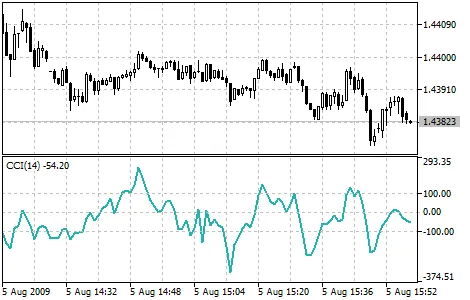
Commodity Channel Index Indicator
How to Calculate the CCI:
1. **Determine the Typical Price (TP)**: Add the HIGH, LOW, and CLOSE prices of each bar, then divide by 3:
TP = (HIGH + LOW + CLOSE) / 3
2. **Calculate the n-period Simple Moving Average (SMA)** of the Typical Prices:
SMA (TP, N) = SUM (TP, N) / N
3. **Subtract the SMA from the Typical Prices** of each of the preceding n periods:
D = TP - SMA (TP, N)
4. **Calculate the n-period SMA of absolute D values**:
SMA (D, N) = SUM (D, N) / N
5. **Multiply the SMA of D values by 0.015**:
M = SMA (D, N) * 0.015
6. **Finally, divide M by D** to get the CCI:
CCI = M / D
Where:
- HIGH - maximum bar price;
- LOW - minimum bar price;
- CLOSE - closing price;
- SMA - Simple Moving Average;
- SUM - sum of values;
- N - number of periods used for calculation.




Comments 0