
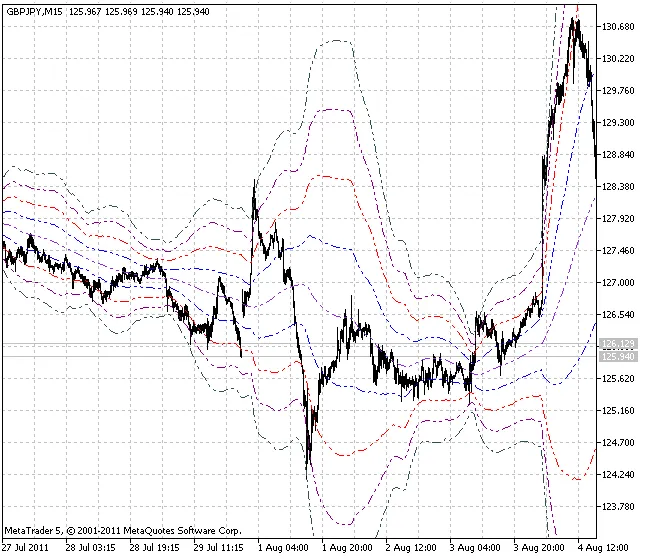
If you're looking to enhance your trading strategy, the Bollinger Bands Set is a fantastic tool that uses more bands than the standard Bollinger Bands® indicator. This expanded set provides greater insight into market movements.
The beauty of this indicator lies in its adjustable "Deviation" parameter, which can range from 1 to 5. By tweaking these settings, you can pinpoint support and resistance levels more accurately. The indicator comes in four different versions, each tailored for various trading scenarios.
Constructed using two averages from the universal average, you can choose from ten different smoothing variants:
- SMA - Simple Moving Average;
- EMA - Exponential Moving Average;
- SMMA - Smoothed Moving Average;
- LWMA - Linear Weighted Moving Average;
- JJMA - JMA Adaptive Moving Average;
- JurX - Ultra Linear Smoothing;
- ParMA - Parabolic Smoothing;
- T3 - Tillson's Multiple Exponential Smoothing;
- VIDYA - Tushar Chande’s Algorithm Smoothing;
- AMA - Perry Kaufman’s Adaptive Smoothing.
It’s important to note that the parameters Phase1 and Phase2 have different meanings across various smoothing algorithms. For example, in JMA, Phase is an external variable that ranges from -100 to +100. In T3, it’s a smoothing ratio multiplied by 100 for better visualization. VIDYA uses a CMO oscillator period, while AMA has a slow EMA period. By default, the fast EMA period in AMA is set to 2, with a growth factor of 2 as well.
This indicator leverages the SmoothAlgorithms.mqh class library (make sure to copy it to terminal_data_folderMQL5\Include). You can find more about its usage in the article "Price Average Series for Intermediate Calculations Without Using Additional Buffers".




Comments 0