
Creator:
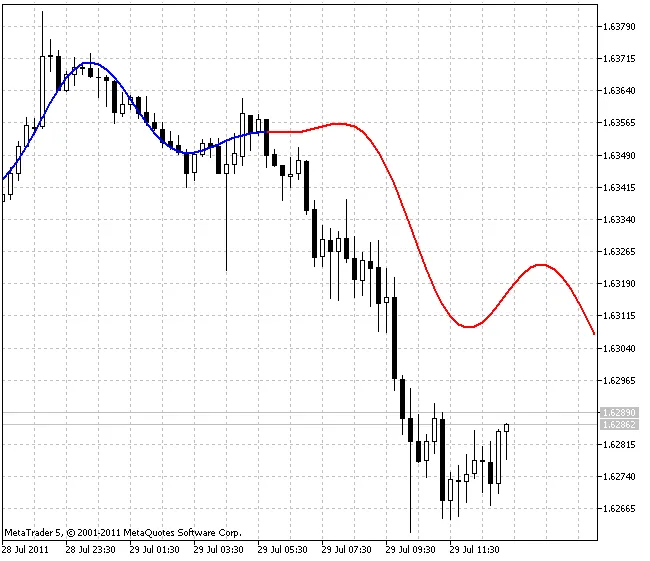
If you're looking to get a leg up in your trading game, the Extrapolator might just be the tool you need. Born from extensive research in Timeseries Forecasting, this powerful indicator gives you a sneak peek into future price movements. With two distinct lines on your chart, the blue line represents model prices based on past data, while the red line forecasts where prices are headed next.
What sets the Extrapolator apart is its versatility. You can choose from a variety of forecasting methods, thanks to the Method input variable:
- Fourier's series extrapolation, using the Quinn-Fernandes Algorithm to calculate frequencies;
- Autocorrelation Method;
- Weighted Burg Method;
- Burg Method with Helme-Nikias weighting function;
- Itakura-Saito (geometric) method;
- Modified covariance method.
Methods 2-6 are all about linear prediction, which means they forecast future values based on previous price movements. Picture this: you have a range of prices from x[0] to x[n-1], where older prices correlate with the more recent ones. The future price, x[n], is calculated as follows:
x[n] = -Sum(a[i]*x[n-i], i=1..p)
In this formula:
- a[i=1..p] - these are your model ratios;
- p - refers to the model structure.
Methods 2-6 work to minimize the mean-root-square error across the last training bars. While it’s possible to achieve zero error forecasts on training bars using the Levinson-Durbin algorithm with n=2*p, this approach can lead to unstable future forecasts. That's why the Prony Method, although effective in theory, isn't included in this indicator.
Here’s a quick rundown of other input parameters you can tweak:
- LastBar: index of the last bar from your historical data;
- PastBars: number of previous bars to use for predicting future values;
- LPOrder: linear module structure ratio (0 to 1);
- FutBars: number of future bars you want to forecast;
- HarmNo: max frequencies for Method 1 (set to 0 to include all frequencies);
- FreqTOL: tolerance for frequency calculation accuracy in Method 1 (greater than 0.001 may not converge);
- BurgWin: weighting function index for Method 2 (0=Rectangular, 1=Hamming, 2=Parabolic);
This innovative indicator was first rolled out in MQL4 and made its debut on Code Base at mql4.com on December 9, 2008.




Comments 0