
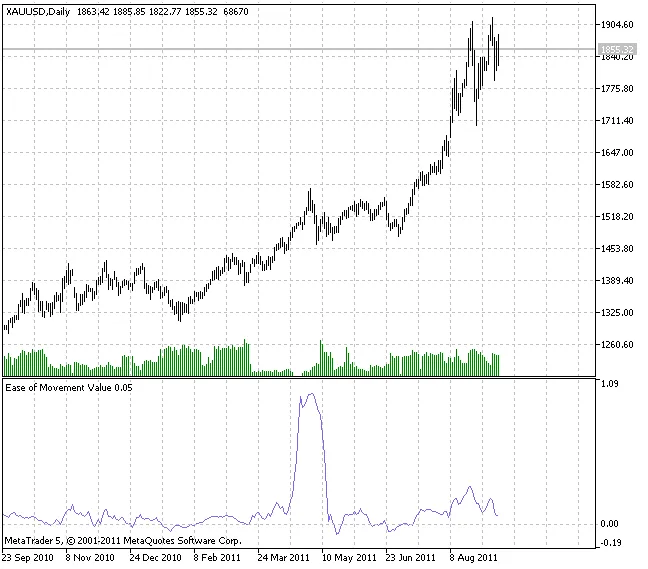
The Ease of Movement (EMV) indicator is a powerful tool in the trader's toolkit, designed to show the relationship between price changes and market volume.
Originally developed by Richard W. Arms, Jr., the same mind behind the well-known Arms Index, EMV is calculated by taking the ratio of the Midpoint Move to the volume (Volume / (High - Low)).
Here's the basic formula:
EMV = Midpoint Move / (Volume / (High - Low))
Where:
- Midpoint Move = (Today's High + Today's Low) / 2 - (Yesterday's High + Yesterday's Low) / 2
Typically, the EMV values are smoothed using a moving average, with a common period set to 14 candlesticks.
What Does EMV Tell You?
- When EMV rises, it indicates that prices have increased with low volume, hinting that a price change could be coming soon.
- If EMV is falling, it shows that prices are decreasing on low volume, which may also signal an upcoming price shift.
- A near-zero EMV suggests a "heavy market," meaning significant volume is required to influence price movements in the short term.
Large positive EMV values indicate rising prices with low volume, while significant negative values suggest falling prices under similar conditions.
Trading Signals
Signals:
- A buy signal occurs when EMV crosses above the zero line.
- A sell signal is generated when EMV dips below the zero line.
The indicator illustrates that when the price movement range is narrow and volume is "heavy," the market experiences less movement freedom.
Choosing Your Smoothing Type
This indicator allows you to select from ten different smoothing types:
- SMA - Simple Moving Average
- EMA - Exponential Moving Average
- SMMA - Smoothed Moving Average
- LWMA - Linear Weighted Moving Average
- JJMA - JMA Adaptive Average
- JurX - Ultralinear Smoothing
- ParMA - Parabolic Smoothing
- T3 - T3 Smoothing
- VIDYA - VIDYA Smoothing
- AMA - AMA Smoothing
Keep in mind that the phase parameters for different smoothing algorithms have unique meanings. For example, JMA uses an external Phase variable ranging from -100 to +100, while T3 uses a smoothing ratio multiplied by 100 for clarity. Understanding these differences can help you optimize your EMV usage.
Additionally, the indicator relies on the SmoothAlgorithms.mqh library classes, which must be placed in the terminal_data_folder\MQL5\Include. You can find detailed usage instructions in the article "Averaging Price Series for Intermediate Calculations Without Using Additional Buffers".




Comments 0