
Welcome back, fellow traders! Today, we're diving into the upgraded version of the Previous Candle Breakdown 2, and I can’t wait to share what’s new!
One of the key additions is the Maximum Volume Position parameter. This feature helps you manage your positions more effectively. Here’s how it works:
- Maximum Volume Position: This is the maximum volume of your open positions.
Let’s say you have a total position volume of 2.5 lots, and your Maximum Volume Position is set at 3.3 lots. If you receive a trading signal and check your existing position volume, which is at 1.5 lots, you’ll find that 2.5 + 1.5 exceeds 3.3. Therefore, no new position will be opened.
The EA (Expert Advisor) is designed to watch for breakdowns across any timeframe, from 1 minute to 1 month. It checks Bar #1 for a breakdown at the specified timeframe of the Previous Candle Breakdown. Plus, you can enable two filters using Moving Averages for extra precision.
Another great feature is the trailing stop functionality, which moves your Stop Loss to breakeven upon the first adjustment, helping to lock in profits.
When it comes to position sizing, you have options! You can choose a fixed lot size (with Lots set above zero and Risk at zero) or calculate it dynamically based on risk percentages per trade (with Risk above zero and Lots set to zero).
Important: Avoid scenarios where both Lots and Risk are greater than zero, or both are set to zero.
Once your target profit is reached, you can set the EA to Close All Positions When Profit is Achieved, ensuring that no more than one position in each direction is opened based on the Previous Candle Breakdown.
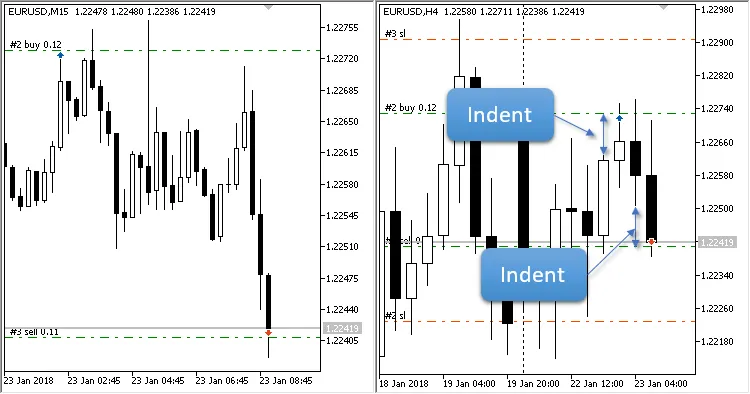
Fig. 1. Current timeframe: M15, breakdown set to H4
Inputs
- Previous Candle Breakdown: The timeframe for the candlestick to break down;
- Indent from High or Low: Distance from the High or Low of the broken candlestick;
- Fast: av. period: The averaging period for the Fast Moving Average; setting it to zero disables the Fast and Slow filters;
- Fast: horizontal shift: The horizontal shift for the Fast Moving Average;
- Fast: type of price: The price type used for the Fast Moving Average calculation;
- Slow: av. period: The averaging period for the Slow Moving Average; setting it to zero disables the Fast and Slow filters;
- Slow: horizontal shift: The horizontal shift for the Slow Moving Average;
- Slow: type of price: The price type used for the Slow Moving Average calculation;
- Fast and Slow: smoothing type: The averaging type common to both Fast and Slow;
- Stop Loss: Your designated Stop Loss;
- Take Profit: Your designated Take Profit;
- Trailing Stop: The trailing mechanism that acts as breakeven upon the first Stop Loss adjustment;
- Trailing Step: The step for the trailing stop;
- Lots: Fixed lot size (set Risk to zero);
- Risk: Dynamic lot size calculated based on risk percentages (set Lots to zero);
- Maximum Number of Positions in One Direction: Limit the number of open positions in one direction;
- Maximum Volume Position: The maximum volume allowed for positions;
- Close All Positions When Profit is Achieved: Automatically close positions at profit.




Comments 0