
Theory:
When it comes to the Relative Strength Index (RSI), Welles Wilder introduced a unique twist by incorporating the "Wilder EMA" into its calculation. If you’re curious about the details, you can dive deeper into it here: Double Smoothed Wilder's EMA. Although Wilder never explicitly stated why he chose this particular EMA, we can infer that he aimed to minimize the number of signals generated by the RSI. If he had relied on a standard EMA, the signals would have been notably more frequent, making the RSI quite jittery.
This version tackles that issue head-on, while also addressing the common problem of RSI flattening—when the RSI stays flat for extended periods. Instead of the conventional Wilder's EMA, we’re using the double smoothed Wilder's EMA, which offers several advantages:
- It adds a layer of smoothing to the RSI (not excessively, but the difference in smoothness is often quite significant).
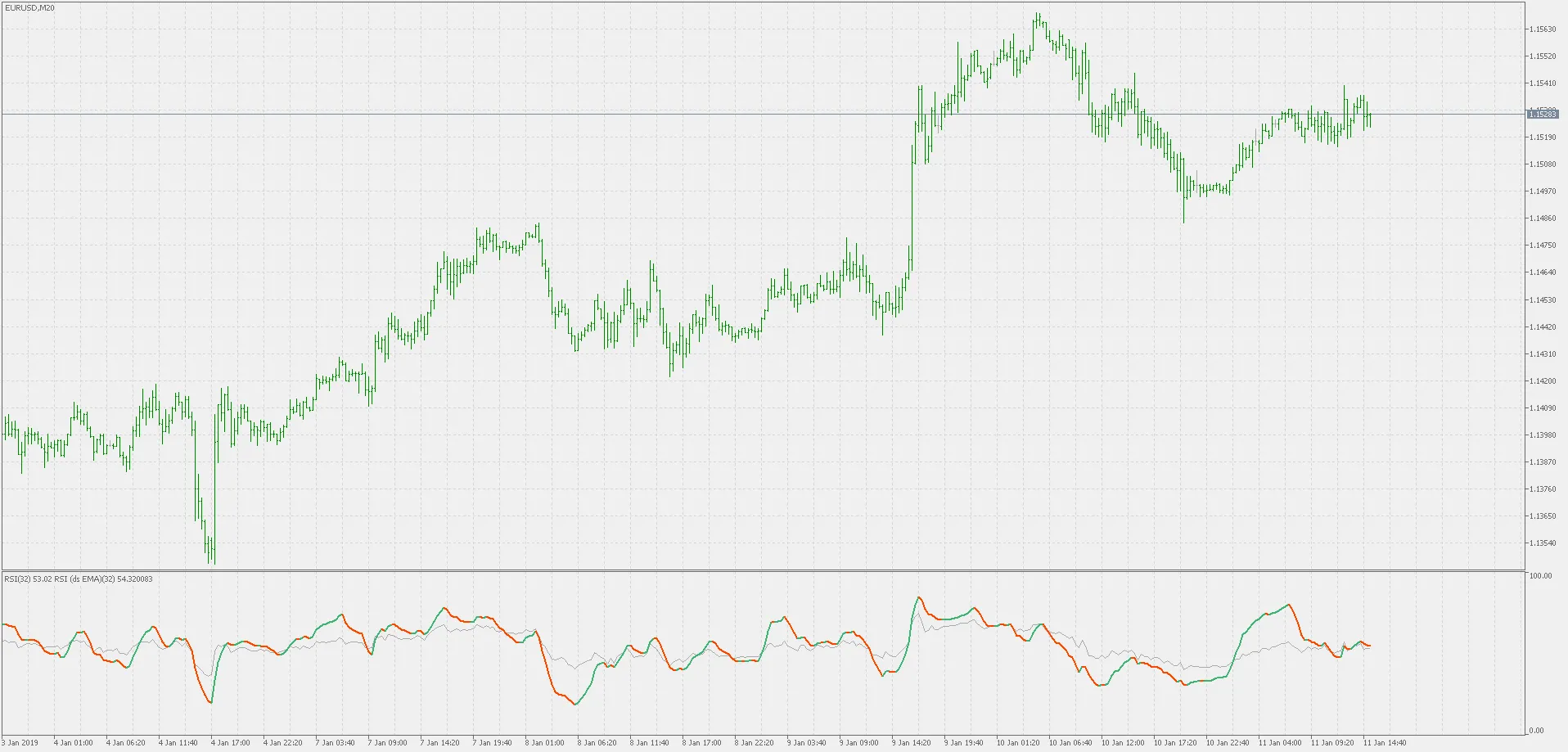
- It helps prevent excessive flattening of the RSI (check out the "big picture" example below).
Usage:
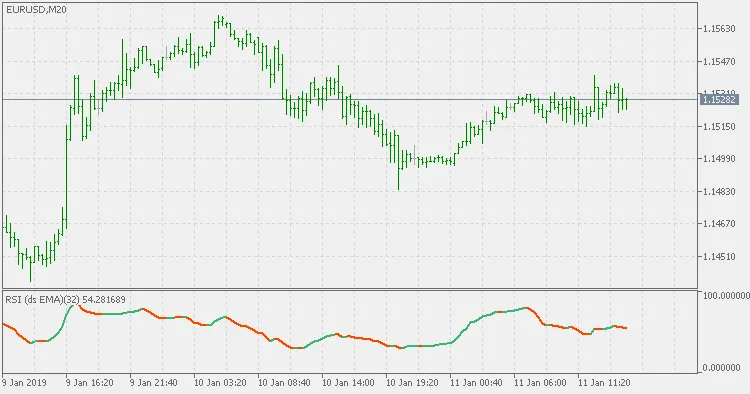
You can leverage this indicator just like any other RSI.
PS:
Take a look at this "big picture" example contrasting the regular RSI (in gray) with this enhanced version (in color). As you can see, this adaptation successfully avoids excessive flattening, allowing the slope to maintain a much smoother appearance compared to the traditional RSI.




Comments 0