
Author:Victor
What is the Hodrick-Prescott Channel?
The Hodrick-Prescott Channel is an enhanced version of the traditional channel used in MQL5, now adapted for MQL4. This powerful indicator helps traders analyze market trends more effectively.
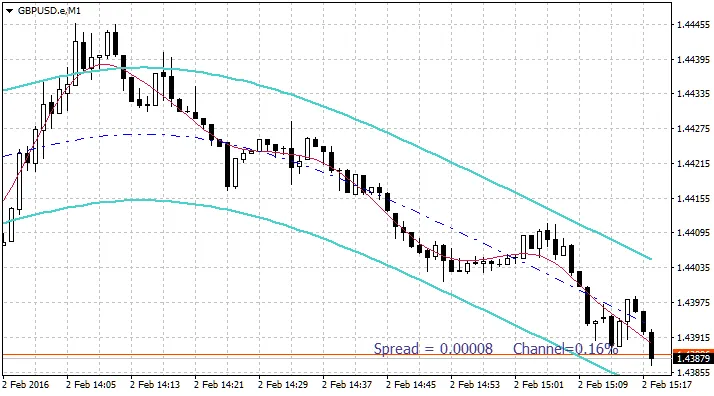
Here’s how it works: first, the indicator calculates filtered Close price values, and then applies a broader filtering period. This results in two arrays known as HP and HPSlow. Next, it calculates the standard deviation of HP in relation to HPSlow and plots the channel on your chart.
On the bottom right corner of the chart, you’ll see the average spread value along with the percentage width of the channel compared to the HPSlow value. You can easily reposition this text label by double-clicking on it, and if you need to remove it, just hit the DEL key. Don’t worry; the label will reappear when you switch timeframes.
How to Interpret the Hodrick-Prescott Channel?
This channel utilizes the Hodrick-Prescott filter, a type of digital filter that operates without delays. While these filters can look more appealing than Moving Averages, they do redraw with each new bar, which can confuse new traders.
So, why does this happen? Simply put, it’s mathematically impossible to create a filter that’s completely “honest” without some delays. Any filter will have a delay that matches or exceeds the number of bars set for averaging. You can see this by tweaking the period in the Moving Average indicator: the longer the period, the smoother the output, but also the longer the delay.
To reduce delay, the algorithm needs to filter input bars from left to right, and then apply a second filter from right to left. The order of filtering doesn’t matter; what counts is that the second pass goes in the opposite direction.
Different filters without delays provide various balances between smoothing and delay, but keep in mind that achieving perfection is nearly impossible since we can’t predict the future.
This channel is best used for gauging immediate price movement direction (within a few bars). If you have both this channel and the Standard Deviation channel on the same chart, you’ll notice their directions closely align near the newer bars. However, while the Standard Deviation channel shows historical price direction accurately to a certain extent, the further back you go, the less accurate it becomes.
During the MQL4 adaptation process, I added a feature that draws the channel’s “tails.” To see this in action, run it on the M1 timeframe, let it sit for about half an hour without changing the timeframe, and you’ll observe the channel wagging its “tail.” Note that the “tail” will disappear if you switch timeframes.
This indicator is best suited for scalping strategies and isn’t recommended for long-term trading or as a substitute for a traditional Moving Average.
Input Parameters for the Indicator:
- HP Fast Period — the period for HP filtering;
- HP Slow Period — the period for HPSlow filtering;
- FontColor — the color of the font.




Comments 0