
Description:
The Relative Strength Levy (RSL) indicator is built on the principle that securities showing strong relative performance in the past are likely to maintain that trend in the future. Essentially, it compares past performance with the most recent observation period.
Calculation:
This indicator calculates the arithmetic mean of the closing prices over a specified observation period. The results are then plotted around the 1.0 mark for easy interpretation.
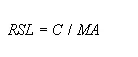
Here, 'C' stands for Close, and 'MA' refers to the Moving Average.
Interpretation:
- If an instrument shows an RSL greater than 1, it indicates that the instrument has been performing stronger than average over the observed period.
- The second interpretation of the Levy involves dividing the standard deviations of the last 27 weekly closing prices. This method aims to gauge the volatility of the observed securities.




Comments 0