
The Exp_FisherTransform_X2 is a powerful trend trading system designed for MetaTrader 5. It leverages signals from two Fisher Transform indicators, enabling traders to identify and capitalize on market trends effectively.
How It Works
The first Fisher Transform indicator provides insights into the direction of the slow trend by analyzing the positions of the main and signal lines. Meanwhile, the second indicator signals the optimal time to open a trade when these lines intersect or touch. A trading signal is generated when the following two conditions are met:
- Both fast and slow trend signals align.
- The direction of the fast trend experiences a change.
Input Parameters for the EA
Here are the key input parameters for the Exp_FisherTransform_X2:
//| Input parameters of the EA indicator |
//+-------------------------------------------------+
inputstring Trade="Trade management"; //+============== TRADE MANAGEMENT ==============+
inputdouble MM=0.1; //Share of a deposit in a deal
input MarginMode MMMode=LOT; //lot value detection method
inputuint StopLoss_=1000; //Stop Loss in points
inputuint TakeProfit_=2000; //Take Profit in points
inputstring MustTrade="Trade permissions"; //+============== TRADE PERMISSION ==============+
inputint Deviation_=10; //max. price deviation in points
inputbool BuyPosOpen=true; //Permission to enter long position
inputbool SellPosOpen=true; //Permission to enter short position
//+-------------------------------------------------+
//| Input parameters of the filter indicator |
//+-------------------------------------------------+
inputstring Filter="PARAMETERS FOR SLOW TREND"; //+============== PARAMETERS FOR SLOW TREND ==============+
inputENUM_TIMEFRAMES TimeFrame=PERIOD_H6; //1 Chart period for the trend
inputuint Length=10;// indicator smoothing ratio
inputuint SignalBar=1; //bar index for getting an entry signal
inputbool BuyPosClose=true; //Permission to exit long positions by trend
inputbool SellPosClose=true; //Permission to exit short positions by trend
//+-------------------------------------------------+
//| Input parameters of the entry indicator |
//+-------------------------------------------------+
inputstring Input="ENTRY PARAMETERS"; //+=============== ENTRY PARAMETERS ===============+
inputENUM_TIMEFRAMES TimeFrame_=PERIOD_M30; //2 Chart period for the entry
inputuint Length_=10; // indicator period
inputuint SignalBar_=1;//bar index for getting an entry signal
inputbool BuyPosClose_=false; //Permission to exit long positions by signal
inputbool SellPosClose_=false; //Permission to exit short positions by signal
//+-------------------------------------------------+
Note that any string parameters in the input settings are purely for enhancing the visualization of the Expert Advisor's input parameters window.
The FisherTransform_HTF indicators included in the EA are designed solely for better visualizing trends during strategy testing. They remain inactive in other operational modes.
To set up the EA, make sure to place the FisherTransform.ex5 and FisherTransform_HTF.ex5 compiled files in your <terminal_data_folder>\MQL5\Indicators directory.
Additionally, the TradeAlgorithms.mqh library file facilitates the use of Expert Advisors with brokers who offer nonzero spreads and allow setting Stop Loss and Take Profit simultaneously with position openings. You can find more variations of this library at the following link: Trade Algorithms.
The default input parameters for the Expert Advisor were utilized in the tests presented below. Note that Stop Loss and Take Profit were not applied during these tests.
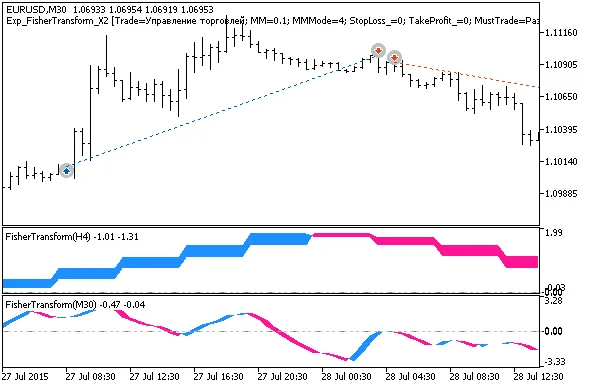
Fig. 1. Examples of deals on the chart
Testing results from 2015 on EURUSD, analyzing slow trends on H4 and fast entry on M30:
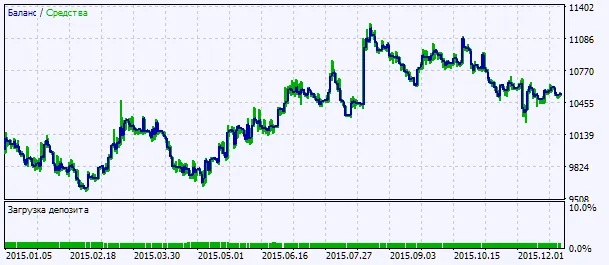
Fig. 2. Chart of testing results




Comments 0