Technical Indicator

Mastering Daily Pivot Points: Your Guide to Navigating Market Trends
MetaTrader4
Mastering Daily Pivot Points: Your Guide to Navigating Market Trends

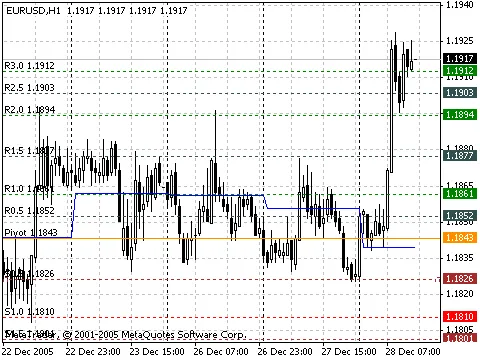
If you're looking to stay ahead of the game in trading, the Daily Pivot Points indicator is a tool you don't want to overlook. Unlike many other indicators that lag behind, Daily Pivot Points give you a clear forecast of potential market movements. This handy indicator calculates reference points based on the previous day’s trading data, helping you identify short-term trends for the current day. The key concept here is the Pivot Point (PP), which acts as a balance point where prices tend to gravitate throughout the day. By using the previous day’s High, Low, and Close values, you can derive 13 different levels: the Pivot Point itself, 6 resistance levels, and 6 support levels. Collectively, these are known as reference points, and they can make spotting short-term trend changes a breeze. The three most critical values to watch are the Pivot Point, Resistance1 (RES1.0), and Support1 (SUP1.0). As price fluctuates between these reference levels, you might notice some interesting patterns, including potential reversals or breakouts. So, what exactly does the Daily Pivot Points indicator do? It forecasts the range of price fluctuations. It indicates potential stopping points for the price. It highlights possible reversal points in price direction. When the market opens above the Pivot Point level, it’s often a solid signal to consider going long. Conversely, if it opens below the Pivot Point, it might be a day to think about short positions. The strategy here is to monitor and identify likely reversals or breakouts at the resistance (RES1.0) and support (SUP1.0) levels. Typically, by the time the price hits the RES2.0, RES3.0 or SUP2.0, SUP3.0 levels, the market is either overbought or oversold, making these great exit points. How to Calculate Daily Pivot Points Using the previous day’s HIGH, LOW, and CLOSE, you can easily generate the following levels: Pivot Point (PP) Resistance1 (RES1.0) Resistance2 (RES2.0) Resistance3 (RES3.0) Support1 (SUP1.0) Support2 (SUP2.0) Support3 (SUP3.0) Intermediate values: RES0.5, RES1.5, RES2.5, SUP0.5, SUP1.5, SUP2.5 To put it simply, you’re projecting the highest and lowest prices of the previous day into the future. PP = (HIGH + LOW + CLOSE) / 3 RES1.0 = 2*PP - LOW RES2.0 = PP + (HIGH - LOW) RES3.0 = 2*PP + (HIGH – 2*LOW) SUP1.0 = 2*PP – HIGH SUP2.0 = PP - (HIGH – LOW) SUP3.0 = 2*PP - (2*HIGH – LOW) RES0.5 = (PP + RES1.0) / 2 RES1.5 = (RES1.0 + RES2.0) / 2 RES2.5 = (RES2.0 + RES3.0) / 2 SUP0.5 = (PP + SUP1.0) / 2 SUP1.5 = (SUP1.0 + SUP2.0) / 2 SUP2.5 = (SUP2.0 + SUP3.0) / 2 Where: HIGH — the highest price of the previous day; LOW — the lowest price of the previous day; CLOSE — the close price of the previous day; PP — pivot point (the typical price of the previous day); RES0.5, RES1.0, RES1.5, RES2.0, RES2.5, RES3.0 — reference points (resistance levels); SUP0.5, SUP1.0, SUP1.5, SUP2.0, SUP2.5, SUP3.0 — reference points (support levels).

2005.12.24
Understanding the Relative Vigor Index (RVI) for Smart Trading Decisions
MetaTrader4
Understanding the Relative Vigor Index (RVI) for Smart Trading Decisions

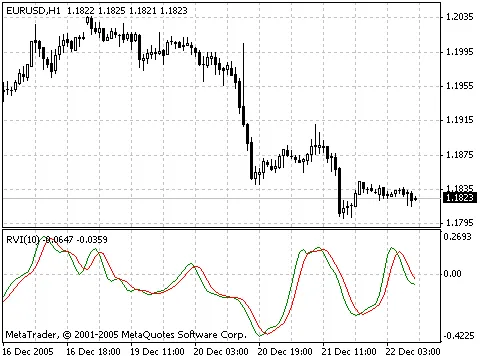
Hey there, fellow traders! Today, we’re diving into the ins and outs of the Relative Vigor Index (RVI). This nifty indicator can really help you gauge the strength of market movements. So, what’s the deal with the RVI? In a bull market, you’ll typically find that the closing price is higher than the opening price. Flip that around for a bear market, where the opposite tends to hold true. The RVI measures the "vigor" or energy behind price movements, based on where prices close at the end of the trading session. To make sense of the index relative to the daily trading range, we normalize it by dividing the price change by the maximum price range of the day. For smoother calculations, we apply a symmetrically weighted moving average that takes into account the differences between closing and opening prices, as well as the maximum and minimum prices of each bar. Generally, a period of 10 is recommended for computing the indicator. To clear up any confusion, it's a good practice to set up a signal line—a symmetrically weighted moving average of the RVI values. When these lines converge, it’s time to pay attention; it can signal a potential buy or sell opportunity. How to Calculate the RVI Here’s the formula breakdown: VALUE1 = ((CLOSE - OPEN) + 2 * (CLOSE (1)) – OPEN (1)) + 2*(CLOSE (2) – OPEN (2)) + (CLOSE (3) – OPEN (3))) / 6VALUE2 = ((HIGH - LOW) + 2 * (HIGH (1) – LOW (1)) + 2*(HIGH (2)- LOW (2)) + (HIGH (3) – LOW (3))) / 6NUM = SUM (VALUE1, N)DENUM = SUM (VALUE2, N)RVI = NUM / DENUMRVISig = (RVI + 2 * RVI (1) + 2 * RVI (2) + RVI (3)) / 6 Where: OPEN — the opening price; HIGH — the highest price; LOW — the lowest price; CLOSE — the closing price; VALUE1 — symmetrically weighted moving average of the differences between closing and opening prices; VALUE2 — symmetrically weighted moving average of the differences between the highest and lowest prices; NUM — total of N importances of VALUE1; DENUM — total of N importances of VALUE2; RVI — value of the Relative Vigor Index for the current bar; RVISig — value of the RVI signal line for the current bar; N — period of the smoothing. If you want to delve deeper, you can find a full description of the Relative Vigor Index over at MetaTrader 5's Technical Analysis on RVI. Happy trading!

2005.12.22
Understanding the Money Flow Index (MFI) for Better Trading Decisions
MetaTrader4
Understanding the Money Flow Index (MFI) for Better Trading Decisions

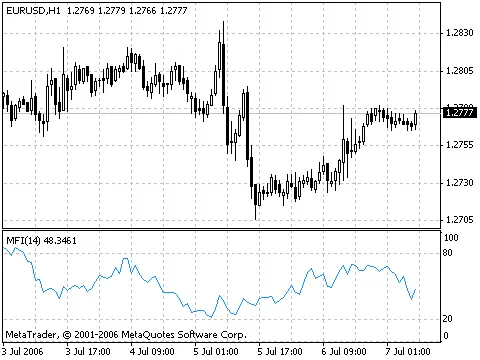
The Money Flow Index (MFI) is a powerful tool that helps traders gauge the pace at which money is flowing into and out of a security. Think of it as a pulse check on market sentiment! Much like the Relative Strength Index (RSI), the MFI provides insights into price momentum, but with a key twist: it also factors in trading volume, making it a handy indicator for those looking to capitalize on market movements. When diving into the MFI, here are a few critical points to keep in mind: Divergences: Watch for discrepancies between the MFI and price action. If prices are climbing while the MFI is dropping (or the other way around), it could signal an impending price reversal. Threshold Levels: An MFI reading above 80 or below 20 can indicate that a security is potentially reaching a market peak or bottom, respectively. These levels can be goldmines for savvy traders! How to Calculate the MFI Calculating the MFI involves several steps, starting with determining the typical price (TP) for the period you're analyzing: TP = (HIGH + LOW + CLOSE) / 3 Next, you'll want to calculate the Money Flow (MF): MF = TP * VOLUME If today's typical price is higher than yesterday’s, you’ve got a positive money flow. Conversely, if it’s lower, that’s negative money flow. Sum up the positive flows for your chosen timeframe to get the total positive money flow, and do the same for negative flows. Now, let’s find the money ratio (MR) by dividing the positive money flow by the negative money flow: MR = Positive Money Flow (PMF) / Negative Money Flow (NMF) Finally, plug your money ratio into this formula to get the MFI: MFI = 100 - (100 / (1 + MR)) If you’re hungry for more detailed insights on the MFI, check out the Technical Analysis: Money Flow Index on MetaTrader.

2005.12.21
Understanding Standard Deviation: Your Guide to Market Volatility
MetaTrader4
Understanding Standard Deviation: Your Guide to Market Volatility

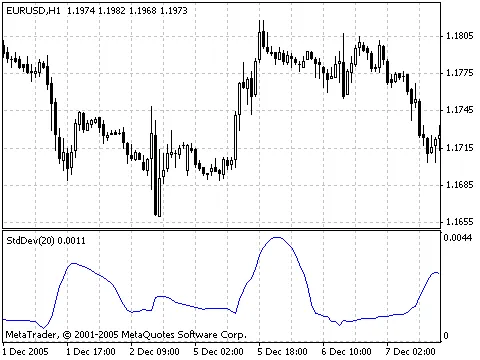
The Standard Deviation Indicator (often referred to as StdDev) is a key tool for measuring market volatility. It essentially tells us how much the prices deviate from the moving average. When the Standard Deviation is high, it indicates that the market is quite volatile, meaning prices are scattered significantly around the moving average. On the flip side, a low Standard Deviation suggests a stable market, where prices are closely clustered around the moving average. Remember, the market tends to fluctuate between these calm periods and active spikes. So, how do we approach using this indicator? It’s pretty straightforward: If the StdDev value is unusually low, signaling a calm market, it’s reasonable to anticipate an upcoming spike in activity. Conversely, if the StdDev is extremely high, it often suggests that market activity is about to slow down. How to Calculate Standard Deviation StdDev (i) = SQRT (AMOUNT (j = i - N, i) / N) AMOUNT (j = i - N, i) = SUM ((ApPRICE (j) - MA (ApPRICE (i), N, i)) ^ 2) Where: StdDev (i) — Standard Deviation of the current bar; SQRT — square root; AMOUNT(j = i - N, i) — sum of squares from j = i - N to i; N — smoothing period; ApPRICE (j) — applied price of the j-th bar; MA (ApPRICE (i), N, i) — moving average of the current bar for N periods; ApPRICE (i) — applied price of the current bar. For a comprehensive look at the StdDev indicator, check out the Technical Analysis: Standard Deviation section.

2005.12.21
Understanding the Force Index (FRC) for Better Trading Decisions
MetaTrader4
Understanding the Force Index (FRC) for Better Trading Decisions

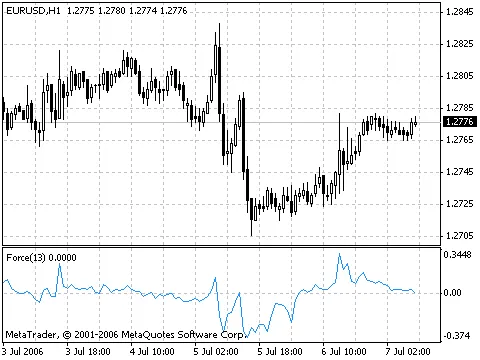
Hey fellow traders! Today, let’s dive into the Force Index (FRC) indicator, a fantastic tool that measures the power of bulls and bears in the market. The Force Index connects the dots between price trends, reversals, and trading volumes. While you can use it on its own, combining it with a Moving Average can really enhance your trading strategy. Using a short moving average (like a 2-period MA) helps pinpoint ideal moments to enter and exit trades. On the other hand, a longer moving average (such as a 13-period MA) reveals broader trends and shifts. Consider buying when the Force Index dips below zero during a bullish trend; The indicator signals a continuation of the upward trend when it reaches a new peak; Look for a sell signal when the index turns positive during a bearish trend; The Force Index indicates bearish strength and trend continuation when it drops to a new low; If price changes don't align with volume shifts, the Force Index will stabilize, hinting that a trend reversal might be on the horizon. How to Calculate the Force Index The strength of market movements is defined by their direction, magnitude, and volume. If the closing price of the current bar exceeds the previous bar's closing price, the force is positive. Conversely, if it’s lower, the force is negative. The larger the price difference, the greater the force. Similarly, higher transaction volumes amplify the force. FORCE INDEX (i) = VOLUME (i) * ((MA (ApPRICE, N, i) - MA (ApPRICE, N, i-1)) where: FORCE INDEX (i) — The Force Index of the current bar; VOLUME (i) — Volume of the current bar; MA (ApPRICE, N, i) — Moving Average of the current bar for N periods: Simple, Exponential, Weighted, or Smoothed; ApPRICE — The applied price; N — The smoothing period; MA (ApPRICE, N, i-1) — Moving Average of the previous bar. For a more in-depth look at the Force Index, check out the Technical analysis: Force Index.

2005.12.17
Understanding Williams Percent Range: A Trader's Guide to %R Indicator
MetaTrader4
Understanding Williams Percent Range: A Trader's Guide to %R Indicator

If you're looking to sharpen your trading skills, then getting to know the Williams Percent Range (%R) can be a game changer. This technical indicator is a handy tool for spotting whether a market is overbought or oversold, helping you make informed decisions. Now, %R is quite similar to the Stochastic Oscillator but with a twist – it features an upside-down scale. To keep things straightforward, you'll want to remember to place a minus sign in front of the %R values (think -30% instead of just 30%). Don’t sweat the minus sign when you're analyzing; it’s just part of how this indicator is displayed. Here's the rundown: when the %R values fall between -80% and -100%, the market is considered oversold. Conversely, if the values hover between -20% and 0%, you’re looking at an overbought market. But hold your horses! Like any good overbought/oversold indicator, it’s wise to wait for a price reversal before jumping into trades. For instance, if the %R suggests an overbought condition, it’s best to wait for the security’s price to dip before you sell. One fascinating aspect of the Williams Percent Range is its knack for predicting price reversals. More often than not, the %R will form a peak and start to decline just a few days before the security’s price hits its peak. Similarly, it creates a trough and begins to rise a few days before the price turns up. How to Calculate %R The calculation for %R is straightforward and resembles that of the Stochastic Oscillator. Here’s the formula: %R = (HIGH(i - n) - CLOSE) / (HIGH(i - n) - LOW(i - n)) * 100 Where: CLOSE — today’s closing price; HIGH(i-n) — the highest high over the last (n) periods; LOW(i-n) — the lowest low over the last (n) periods. For a deep dive into the %R indicator, check out the Technical Analysis: Williams Percent Range.

2005.12.16
Understanding On Balance Volume: A Trader’s Guide
MetaTrader4
Understanding On Balance Volume: A Trader’s Guide

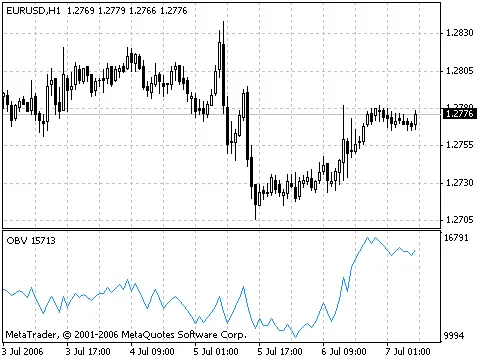
Hey there, fellow traders! Today, let’s dive into the On Balance Volume (OBV) indicator, a handy tool that helps us gauge market momentum by relating volume to price changes. Developed by Joseph Granville, the OBV is pretty straightforward. Here’s the deal: when a security closes higher than its previous close, all of that day’s volume is counted as up-volume. Conversely, if it closes lower, the entire volume is considered down-volume. It’s a simple, yet powerful way to assess market strength. The core idea behind OBV analysis is that changes in OBV often come before price changes. Essentially, when smart money starts flowing into a security, you’ll usually see a rising OBV. Then, when retail traders jump in, both the price and the OBV tend to surge together. But what happens when the price moves without a corresponding OBV change? That’s what we call a “non-confirmation.” You’ll often see these at market tops during bullish trends (when prices rise before the OBV does) or at market bottoms in bearish trends (when prices drop without the OBV confirming the move). When the OBV is on the rise, you’ll notice each new peak is higher than the last, and each trough is also climbing. In contrast, the OBV is in a downward trend if each peak and trough is lower than the previous ones. If the OBV is moving sideways without making new highs or lows, it’s a sign of uncertainty. Once a trend is established, it usually sticks around until it gets broken. There are two main ways for the OBV trend to change. The first is a shift from rising to falling, or vice versa. The second is when it transitions into a doubtful trend—and if that doubt sticks around for more than three days, that’s a signal to pay attention. So, if you see the OBV shift to a rising or falling trend, that’s your breakout moment. Typically, OBV breakouts happen before price breakouts, so when you spot an upward breakout, consider taking a long position. On the flip side, if you see a downward breakout, it might be time to short. Just keep your positions open until the trend shifts again. How to Calculate OBV Calculating the OBV is pretty straightforward: If today’s close is greater than yesterday’s close, then: OBV(i) = OBV(i-1) + VOLUME(i) If today’s close is less than yesterday’s close, then: OBV(i) = OBV(i-1) - VOLUME(i) If today’s close is equal to yesterday’s close, then: OBV(i) = OBV(i-1) Where: OBV(i) — is the current period's indicator value; OBV(i-1) — is the indicator value from the previous period; VOLUME(i) — is the volume for the current bar. If you want to dive deeper into OBV, check out the full description in the Technical analysis: On Balance Volume.

2005.12.16
Understanding the Market Facilitation Index (BW MFI) for Better Trading Decisions
MetaTrader4
Understanding the Market Facilitation Index (BW MFI) for Better Trading Decisions

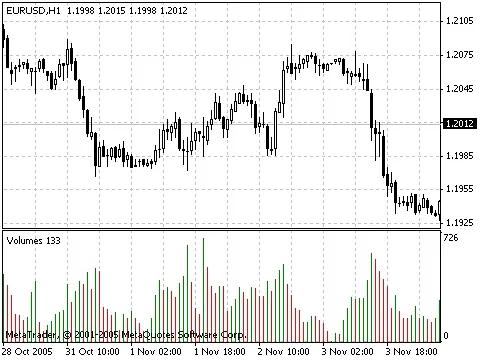
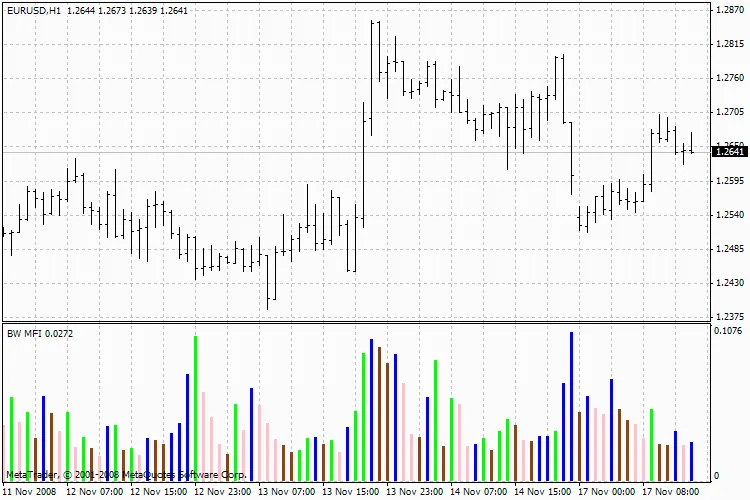
The Market Facilitation Index (BW MFI) is a unique technical indicator that helps us understand price changes for each tick. While the absolute values are not particularly meaningful on their own, it’s the changes in the indicator that we should pay attention to.Market Facilitation Index, BW MFIAccording to Bill Williams, there’s a significant relationship between the MFI and trading volume:MFI rises and volume rises: This indicates that new traders are entering the market, and they are likely taking positions in the direction of the current price movement. In other words, the trend is gaining momentum.MFI falls and volume falls: When both the MFI and volume decrease, it shows that market participants are losing interest.MFI rises while volume falls: This scenario suggests that price changes are not being backed by client volume, indicating that fluctuations may be driven by speculative moves from brokers and dealers.MFI falls but volume rises: Here, we see a tug-of-war between buyers and sellers, with significant trading activity but little change in price. This stalemate indicates that one side will eventually prevail, and a breakout from this type of bar can signal whether the trend will continue or reverse. Bill Williams refers to this as a "curtsying" bar.Calculating the Market Facilitation IndexTo calculate the BW MFI, you’ll subtract the lowest price from the highest price of the current bar and divide that by the volume.BW MFI = RANGE * (HIGH - LOW) / VOLUMEWhere:RANGE — a multiplier that adjusts the price differences to whole numbers;HIGH — the highest price of the current bar;LOW — the lowest price of the current bar;VOLUME — the trading volume for the current bar.Further ReadingFor a comprehensive look at the BW MFI, check out the Technical analysis: Market Facilitation Index.

2005.12.14
Understanding Fractals: A Key Indicator for Traders
MetaTrader4
Understanding Fractals: A Key Indicator for Traders

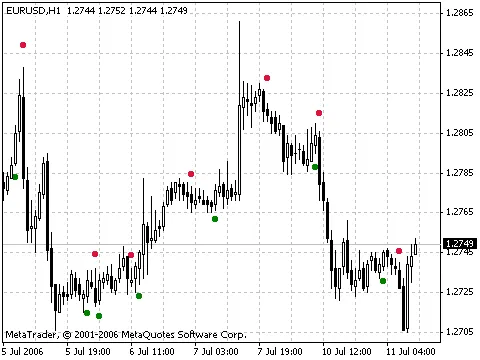
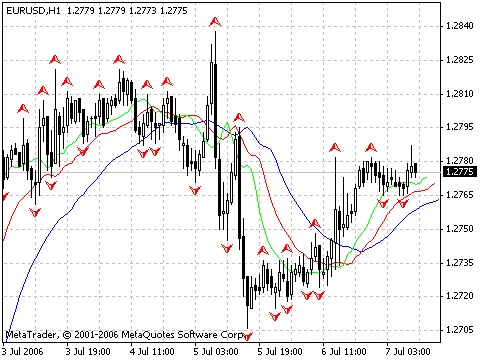
In the trading world, one thing's for sure: prices tend to stay pretty stable most of the time. It's only during brief moments—about 15-30% of the time—that we see significant trend changes. These lucrative moments usually happen when market prices follow a clear trend. Enter the Fractal—one of the five indicators from Bill Williams' trading system. This nifty tool helps us spot potential tops and bottoms in the market. So, what exactly is a Fractal? It’s a pattern formed by at least five consecutive price bars, with the highest high sitting right in the middle and two lower highs on either side. On the flip side, the reversing set consists of five consecutive bars as well, but this time with the lowest low in the center and two higher lows around it, which signals a sell fractal. Fractals are visually represented with up and down arrows, indicating high and low values respectively. Now, here’s the catch: you need to filter these fractals using the Alligator indicator. Essentially, if a fractal appears below the Alligator’s Teeth, it’s not the right time to close a buy position. Conversely, if a fractal is above the Alligator’s Teeth, hold off on closing a sell position. Once a fractal signal is generated and sits beyond the Alligator’s Mouth, it stays in play until it's challenged by a new fractal signal. For a deep dive into Fractals, check out the Technical Analysis: Fractals page.

2005.12.09
Understanding Envelopes: A Key Trading Indicator
MetaTrader4
Understanding Envelopes: A Key Trading Indicator

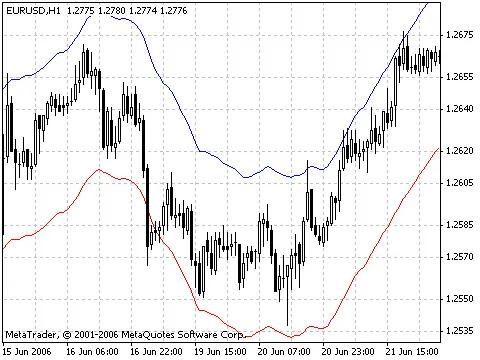
Hey traders! Today, let’s dive into the Envelopes technical indicator, a tool that can be a game-changer in your trading strategy. So, what exactly are Envelopes? At its core, this indicator consists of two Moving Averages. One is shifted upwards, while the other is shifted downwards. This simple setup helps traders identify potential buying and selling opportunities. The key to using Envelopes effectively lies in adjusting the band margins according to market volatility. The more volatile the market, the greater the shift should be. This means that when prices are swinging wildly, your indicator will adapt to better capture those movements. How do Envelopes work? They help define the upper and lower boundaries of the price range. When the price hits the upper band, it’s a signal to consider selling. Conversely, when it touches the lower band, it’s prime time to think about buying. It’s all about recognizing when price extremes are likely to revert to more stable levels, a concept that’s akin to how Bollinger Bands function. Calculation Upper Band = SMA(CLOSE, N)*[1+K/1000]Lower Band = SMA(CLOSE, N)*[1-K/1000] Here’s a quick breakdown of the variables: SMA — Simple Moving Average; N — the period over which you’re averaging; K/1000 — how much you’re shifting from the average (in basis points). If you’re looking for a more in-depth look at Envelopes, check out the Technical Analysis: Envelopes on MetaTrader’s site.

2005.12.07
First Previous 394 395 396 397 398 399 400 401 Next Last